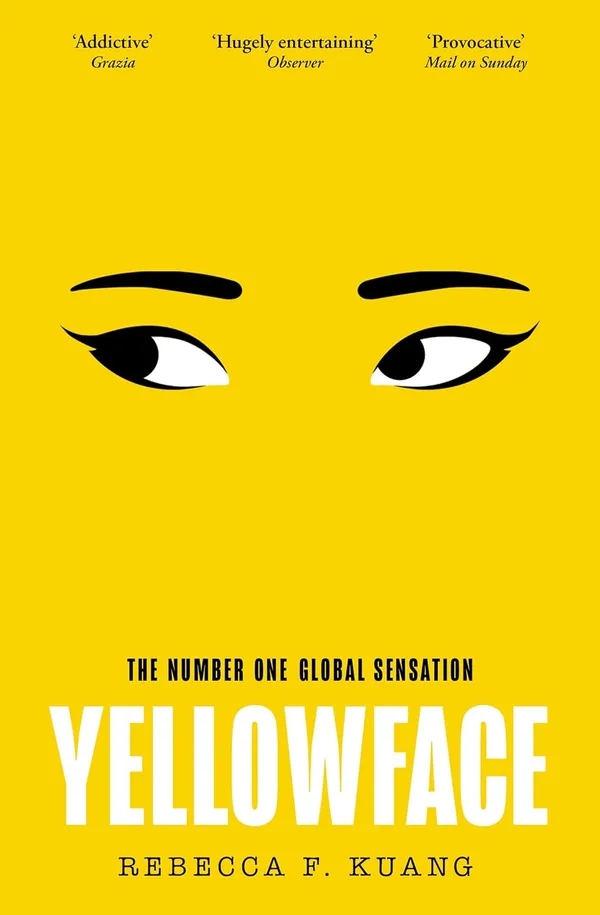
Yellowface
by R.F. Kuang
Book Club Date:February 2025
📖 Book Summary
*Yellowface* by R. F. Kuang starts from the most directly unethical and illegal premise—plagiarizing a manuscript—and drags you headfirst into an even more sensitive and harder-to-articulate battlefield: cultural appropriation, identity politics, and how the publishing industry turns authors into commodities. The protagonist, June, is a mediocre white author whose work nobody reads. When her friend Athena—a rising Chinese American literary star—dies in a freak accident, June steals her unfinished manuscript, rewrites it, repackages it, and publishes it. Propelled by market forces and social media, the story spirals into a dark comedy of "impersonating an Asian author."
✍️ Reading Notes
The most terrifying thing about *Yellowface* isn't how bad June's actions are—it's that you watch her rationalize every single one. Her theft isn't theft; she calls it "tidying up," "polishing," "giving the work a chance to be seen." She isn't impersonating anyone; she calls it a "presentation strategy" that the market will understand better and the media will buy into more easily. The novel's sharpest blade is making you realize: in the age of engagement metrics, morality isn't necessarily the bottom line—morality is more like a tradeable narrative resource. As long as the story is told smoothly enough, even shame can be packaged as a marketing highlight. When we read, do we care more about the story itself or about who the author is? After social media turned creators into "brands," authors are no longer just writers—they're part of the work, even the work's packaging. So when June's identity is questioned, readers' fury often isn't just about "whether she writes well" but about "what gives her the right." This isn't mere moral fastidiousness; it's the power distribution of the modern cultural marketplace: who gets to tell stories, who is believed, whose trauma can be priced, whose accent and face can be marketed as selling points. Thus, when the book discusses "cultural appropriation," the focus isn't solely on "you used someone else's cultural elements." The sharper question is whether you're exploiting someone else's history and pain for your own fame and fortune, under conditions of power asymmetry. The Encyclopædia Britannica's definition of cultural appropriation makes "power imbalance" very clear: when a dominant group appropriates a marginalized group's culture in exploitative, stereotyping, or disrespectful ways, it constitutes appropriation. Apply this framework back to *Yellowface*, and you'll find that June's greatest "success" isn't how well she writes, but how well she understands how to make the work fit the market's expectations for "Asian narrative"—and turn that expectation into her own ladder to the top. What makes *Yellowface* so unputdownable is that it writes all these "common realities within cultural circles" as a slow-burning fire: from manuscript theft, to repackaging, to media manipulation, to social-media mob justice. You'll encounter another key term—cancel culture—functioning like an automated button: once the public determines someone's words or actions are "inappropriate," support is withdrawn and social and professional consequences spread rapidly. But the novel doesn't let you comfortably stand on the "side of justice" either, because you'll simultaneously see that some people are genuinely seeking accountability, some are just enjoying the thrill of a witch hunt, some truly care about cultural harm, and some just want to grab the microphone on the moral stage. By the end, I think *Yellowface* works most like a deeply uncomfortable mirror: it isn't teaching you that "works and authors should be separated" or "absolutely cannot be separated." It's forcing you to admit that every time you say "I only judge the work" or "I refuse to buy it," you're participating in a power allocation—and you're not a bystander; you're one of the votes.
💬 Discussion Points
- 1If a book's content is excellent but the author (or how the author obtained it) is deeply problematic, how would you handle it: refuse to buy, read it but prevent the author from profiting, or separate the work from the author? Why?
- 2Where do you think the boundary of "cultural appropriation" lies: whether sufficient research was done, whether context was respected, whether there's a power imbalance, or whether someone else's trauma was commodified?
- 3Does cancel culture look more like an "accountability mechanism" or "moral gratification" to you? Under what circumstances would you support cancellation, and when would you feel it goes too far?