
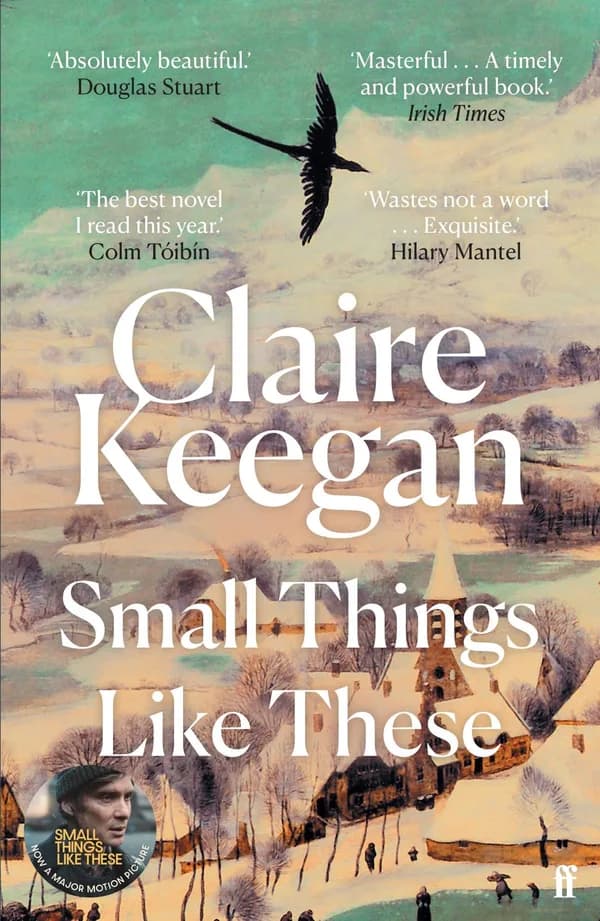
Small Things Like These
by Claire Keegan
Book Club Date:December 2025
📖 Book Summary
Claire Keegan's *Small Things Like These* is short and powerful. Set in an Irish small town just before Christmas 1985, protagonist Bill Furlong is an ordinary coal-and-timber delivery man who accidentally discovers a disheveled, barefoot young woman in a convent laundry, forcing him to choose between conscience and silence. Bill's seemingly insignificant act of kindness becomes the novel's magnifying glass for examining communal complicity and Church power. Keegan's minimalist yet precise language transforms everyday details into moral tension, compelling readers to ask themselves in the silence: what would you do if it were you? The work is regarded as a gentle indictment of collective silence, carrying both warmth and fury. Its taut pacing and weighty themes gained international attention, even leading to a film adaptation and widespread discussion. The aftertaste lingers long. Sometimes the real story doesn't want to be told—"Christmas always brings out the best and worst in people." This book is perfect for savoring slowly during the holiday season.
✍️ Reading Notes
*Small Things Like These* shows us that real violence doesn't need to announce itself loudly—it only needs enough people to simultaneously perform the same small gesture: look away, close their mouths, pretend they didn't see. Keegan's choice of 1985 is surgically precise: it was an era when "everyone knew what was happening, but everyone still called it order." The system Bill sees in the convent isn't explained through lengthy denunciations, because Irish history itself is damning enough—the real-world Magdalene Laundries did exist, operated long-term by Catholic religious orders, where women were forced into unpaid labor, with the last one closing only in 1996. What's even more cruel is that it wasn't that "nobody knew." The Irish government published an investigative report in 2013, specifically addressing the state's relationship with these institutions, and in February of that same year, then-Taoiseach Enda Kenny formally apologized in parliament, acknowledging the state's dereliction and involvement. Placing the novel against this backdrop, Bill's dilemma is painful not because he has to fight "some bad guy," but because he has to fight "an entire town's silence." He has a family, a livelihood, five daughters. Keegan's writing style also functions as a moral experiment: she shrinks "goodness" to its smallest possible size—down to a single sentence, a single action, a single decision to bring someone out from behind a door. And so as you read, you realize the "small things" of the title are actually ironic: in an era of collective silence, any small thing done with willingness to speak up becomes an enormous act. (As an aside, this work has been adapted into a film of the same name starring Cillian Murphy, also set around Christmas 1985.)
💬 Discussion Points
- 1Have you ever encountered a situation in your life where "everyone knew something was wrong, but everyone acted as if it were normal"? Were you the silent one, the bystander, or the person who broke the unspoken agreement?
- 2If you were Bill, what would you fear most: losing your livelihood, losing your community standing, or the realization that "I've become an accomplice too"?
- 3How much do you think "kindness" should reasonably cost? Is there a kind of goodness you'd be willing to do but wouldn't want to be praised for?