
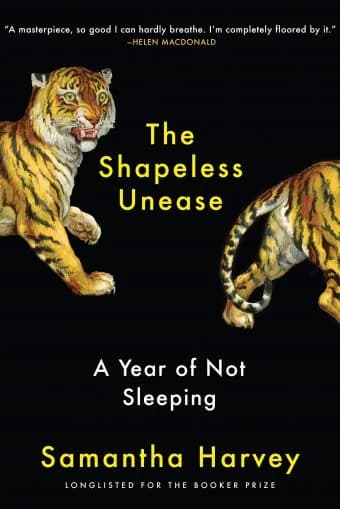
The Shapeless Unease
by Samantha Harvey
Book Club Date:February 2026
📖 Book Summary
The Shapeless Unease is British author Samantha Harvey's account of insomnia — a record of one year spent completely entangled in sleeplessness. Nights burn bright with wakefulness, days blur with exhaustion; time stretches, memory sharpens, and the whole self feels wedged in the gap between "awake" and "about to fall apart." It is not a "sleep-aid manual." It reads more like an insomniac's memoir crossed with philosophical reflection, piecing together the imagination, fear, anger, grief, and leaping thoughts of sleepless nights into an irregular map. Harvey is a novelist and a creative-writing lecturer at Bath Spa University. Her prose is deeply literary, yet her angle is profoundly human: how do you keep living when you lack something as basic as sleep?
✍️ Reading Notes
This book portrays insomnia as a life that has lost its shape — day and night no longer separate, yesterday and today stick together, and emotions drip like an unclosed faucet. You might think insomnia is just "sleeping a bit less," but Harvey describes a more concrete horror: sleeplessness rewrites how you feel about the world. She tried everything — medication, therapy, dietary changes, lifestyle restructuring, relaxation techniques — and still couldn't sleep. What resonates most isn't any checklist of remedies but the harder-to-name cycle: the more you try to sleep, the more anxious you become; the more anxious you are, the wider awake you stay; and after long enough, your body starts believing there are tigers in the room (even though your rational mind knows better). So she began to write — not because writing cures insomnia, but because on those sleepless nights, writing became the only order she could hold onto: naming the chaos, breaking fear into smaller pieces, placing "shapeless unease" into sentences, if only for a moment. You watch her thoughts jump-cut like dreams — death (the loss of loved ones), faith versus science, politics and anger, how memory warps, how language fails and then rescues us. Interestingly, Harvey doesn't only write about suffering. She also captures an eerie clarity: when the protective film of sleep is stripped away, you're forced to stare at things you normally cover up with busyness. So the book reads as though you're studying insomnia yet keep being steered toward the question "what are the bare minimum conditions for staying alive?" Sleep is one, but it also stands for much more: a sense of safety, the feeling of being cared for, the right to switch off. I'd recommend The Shapeless Unease to two kinds of readers: 1. Those who truly can't sleep: it won't teach you to fall asleep fast, but at 3 a.m. it will make you feel "someone understands." 2. Those who think they sleep just fine: it will make you suddenly treasure the ability to close your eyes and vanish for a few hours, because that is actually a tremendous gift. (A gentle note: if chronic insomnia has you in its grip, this book makes a wonderful companion — but it cannot replace professional medical assessment and treatment.)
💬 Discussion Points
- 1What thought shows up most often during your "sleepless hour" — work, relationships, death, unfinished business, or "is something wrong with me"?
- 2Which part of insomnia torments you more: the inability to sleep itself, or having to function the next day as if nothing happened?
- 3If you could negotiate with insomnia, what would you trade for a good night's sleep — a little less control, less social media, less sense of responsibility, or less pressure on yourself?