
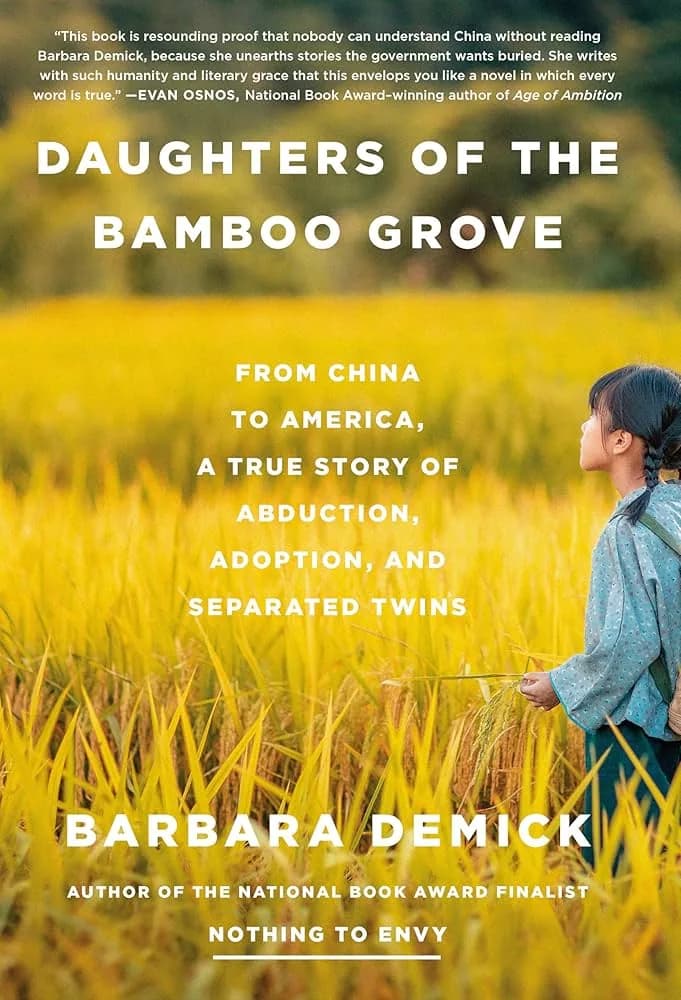
Daughters of the Bamboo Grove
by Barbara Demick
Book Club Date:March 2026
📖 Book Summary
ou can readily list many heartwarming reasons for 'international adoption': saving lives, securing a better future for a child, and a love that transcends borders. But have you ever wondered if, beneath this veneer of 'redemption,' lies a transnational complicity woven from policy oppression and the lure of profit? This is no work of fiction; it is a heartbreaking, true-to-life investigation. At the heart of the story are identical twin sisters, Shuangjie and Esther. Born during the harshest years of China's 'One-Child Policy,' they were forced apart shortly after birth—one left to grow up in rural China, while the other was sent across the Pacific to the United States. Through the divergent fates of these two sisters, the author exposes the harrowing reality of how, from the late 1990s to the early 2000s, local governments in China rebranded 'surplus baby girls' as 'abandoned infants,' effectively transforming them into 'commodities' worth thousands of dollars within the global adoption industry.
✍️ Reading Notes
This work exposes the darkest accomplice structure within the international adoption industry from the late 1990s through the 2000s. The story originates from the heaviest shadow of the One-Child Policy: under the pressure of strict family planning quotas and exorbitant "social maintenance fees," children were quantified as foreign exchange indicators. Demick points out that China’s orphans were not primarily the result of poverty, but rather institutional malice and the lure of money. When the adoption of a single infant could bring thousands of dollars in revenue to an orphanage, the entire system became distorted. Family planning officials forcibly seized children and "laundered" them by forging identities, leading to a collective moral illusion: American adoptive parents firmly believed they were saving lives from the trash heap, unaware that on the other side of the paperwork, many biological parents were desperately and heart-brokenly searching for their children. The turning point lies in the fleeting "Golden Age" between 2001 and 2012. At that time, China briefly opened a window of "openness" for the Olympics, allowing journalists like Demick to act like "fleas attached to the back of a giant beast," venturing deep into rural Hunan to dig for the truth. It was this period of press freedom that allowed her to document how a civilian named "Old Yuan" risked everything to help victimized families. However, with the tightening of power and surveillance after 2012, that window was heavily locked. Digital surveillance replaced human interception, and that era of standing alongside victims to confront the truth has become an almost unbelievable legend to later generations. Reading this book feels like following the journalist’s perspective step-by-step through an investigation, gradually uncovering the truth. It details how the twins were forced apart and how they eventually reunited. The entanglements and tensions—whether it be the pain of the biological parents, the shame and worry of the adoptive parents once they learned the truth, or the confusion and fear of the adoptees—along with the dark reality of the One-Child Policy era, are all described with meticulous detail and a neutral lens. This book serves as a witness to history. It allows us not only to understand the story of these separated twins but also to grasp the historical context and specific details of that era. Furthermore, it witnesses how technological progress has reached heights unimaginable to previous generations, solving many problems (though creating many new ones in the process). I highly recommend this unputdownable book, "Daughters of the Bamboo Grove," to everyone!
💬 Discussion Points
- 1When you discover that your supposed "act of kindness" (such as international adoption) actually fueled another country’s "population plunder," does that kindness remain morally defensible? How should we define this role of the "unknowing accomplice"?
- 2The book mentions that 2001–2012 was the "Golden Age" of investigative reporting. Under today’s environment of digital surveillance and big data management, do you think it is still possible for investigative journalists to uncover truths on the scale of the "Shao’s Orphans" scandal?
- 3If you were an adoptee facing the risks of "secondary abandonment" or "emotional blackmail," would you still choose to use DNA technology to search for your biological family, knowing it might turn your life upside down?