
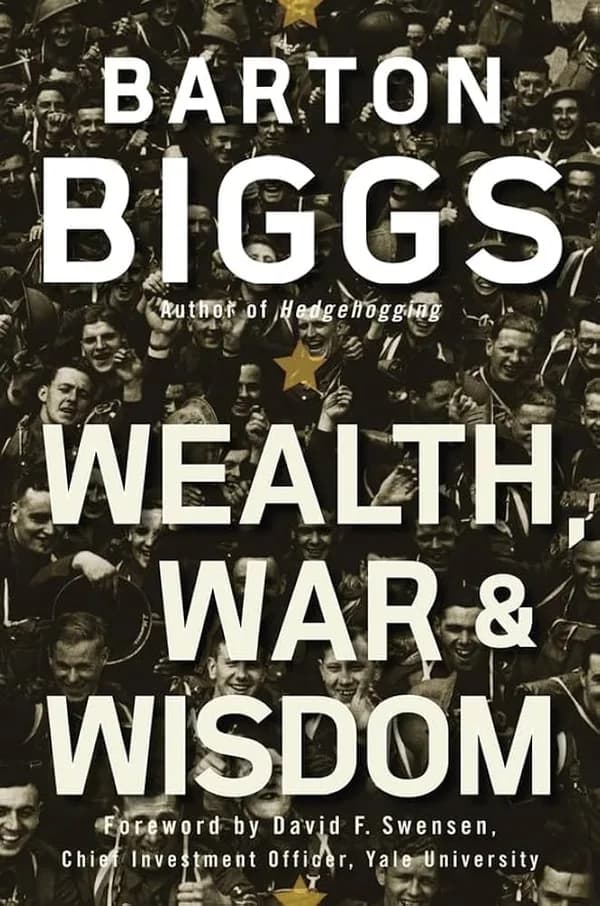
Wealth, War and Wisdom
by Barton Biggs
Book Club Date:August 2024
📖 Book Summary
*Wealth, War & Wisdom* is written by legendary investor and former Morgan Stanley chief strategist Barton Biggs. This is no dry history book—it's a wartime field manual approached from the angle of "asset preservation." By analyzing stock market movements in the US, UK, Germany, Japan, and other nations during WWII, Biggs demonstrates that financial markets not only reflect current economics but also serve as an "early warning system" for major historical turning points. The book is structured like a cross-border "wealth survival experiment": from the eerie rally of the London stock exchange during the Battle of Britain, to the frantic flight of French capital when Germany invaded Paris, to the mania preceding Japan's bubble burst. Through market behavior under extreme wartime conditions, it redefines investor "wisdom"—in such uncertain times, protecting wealth requires not prediction, but a deep understanding of human nature and historical patterns.
✍️ Reading Notes
The most striking insight of this book is the concept of "the market as a collective-wisdom prediction mechanism." Biggs discovered that in the early 1940s, at the most pessimistic moment when London could fall at any time, the British stock market quietly bottomed out and began recovering during the fiercest phase of the Battle of Britain. This reveals that financial market participants, through invisible capital flows, crystallized a kind of "intuition" that transcended public opinion. This market signal was faster than any official news—one or two years before the Allied victory, stock prices had already reflected the tipping of the war's balance. However, the trap investors most easily fall into is "Hindsight Bias." Looking back at WWII or the 2000 dot-com bubble, we always feel the trend "couldn't have been more obvious," but in the real-time flow of events, everything is fog. Even the great economist John Maynard Keynes faced near-bankruptcy in the golden prosperity of the 1920s due to excessive optimism. This shows that when caught in the frenzy of peak asset prices, human greed and avoidance of "long-term thinking" often blind our rational eyes. Regarding the French market's performance, the book depicts a heart-pounding wealth defense battle. When the German army approached Paris, the stock market collapsed and capital fled—what looked like doomsday in the moment was, for "wise" investors, the critical window for asset reallocation. When the stock market became a stagnant pond, French investors decisively pivoted to **gold**, that eternal "safe haven." Even more intriguingly, the stock market's recovery on the eve of D-Day once again confirmed the market's sensitivity as a "historical turning point signal." After reading this book, our book club discussion arrived at a cruel yet truthful conclusion: in extremely turbulent environments, human psychological factors (anxiety, fear, blind chasing of highs) impact the market far more than data. This is an excellent lesson for modern investors: against the current global backdrop of geopolitical risk and economic crisis, observing abnormal market fluctuations can often reveal the future's direction earlier than news reports.
💬 Discussion Points
- 1Biggs argues that stock markets can predict war outcomes. If you were in 1940 London, enduring air raids yet seeing the stock market rising, would you choose to trust "collective wisdom" and buy the dip, or would you consider it the last gasp before a crash and keep clutching gold in your bomb shelter?
- 2Keynes's example teaches us that even top experts can be blinded by current prosperity. In today's global economic environment, what trends do you think might be "invisible bubbles" we can't see because we're inside them? How can we overcome the psychological bias of "this time is different"?
- 3In times of extreme uncertainty, Biggs highlights the different performances of stocks, real estate, and gold. If you were facing a potentially years-long global upheaval, how would you reallocate your assets? Which asset class would be your true "wisdom safe haven"?