
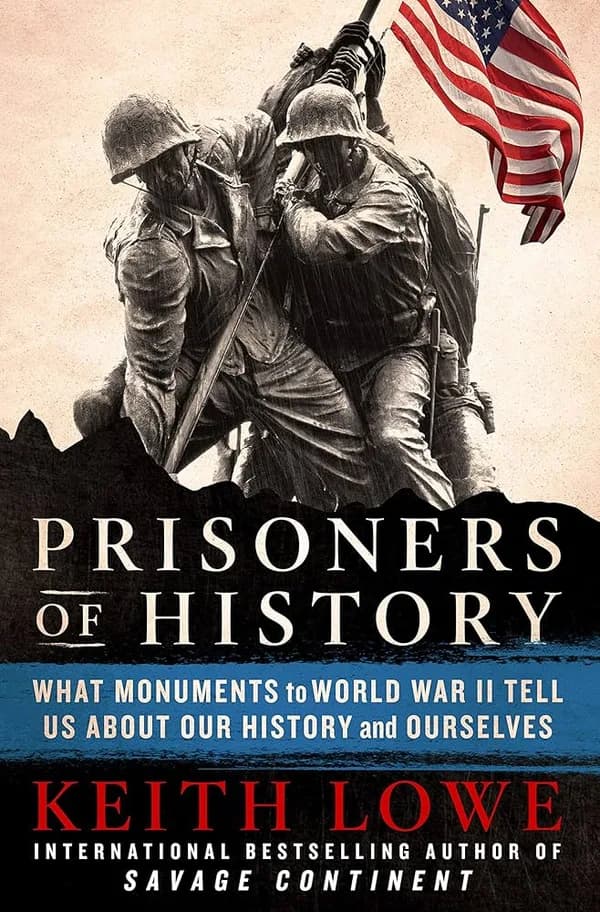
Prisoners of History
by Keith Lowe
Book Club Date:May 2022
📖 Book Summary
*Prisoners of History: What Monuments to World War II Tell Us About Our History and Ourselves* reads like a "travel guide to WWII memory," except it does not show you scenery — it shows you how different countries turn war into story. Author Keith Lowe visits 25 monuments and memorial sites — statues, walls, empty lots, cemeteries, museums, even a footpath — all asking the same question: when people say they are commemorating the past, are they really finding justification for today's positions, and drafting scripts for tomorrow? Sometimes we think we are looking back at history, but more often history is being used to lock us into place. A monument does not merely "remember" — it also decides who is the hero, who is the victim, who deserves sympathy, and who should stay silent. So you will see the same World War II produce solemn victory narratives in one country, abstraction in another, and deliberate silence in yet another.
✍️ Reading Notes
I used to think a monument's function was simple: nail pain to a wall and remind us not to repeat it. After reading this I understood that a monument is more like a kind of "public editing" — trimming messy history into a version that can be shared, passed down, and used to rally unity. The problem is, history was never one clean timeline; it is a tangled ball of string. Tug out "justice" and you often drag along "inconvenient truths." The book's sharpest point is its insistence that every society practises selective memory — because remembering too completely makes life unlivable. You would have to face the fact that your side also did terrible things, that those you consider victims might be perpetrators in someone else’s story, and that the people you want to honour may have simultaneously suffocated another group. So many monuments look like they are talking about the past, but are really negotiating "what kind of community do we want to be." The memorial in the centre of Ljubljana — two plain white walls, almost no narrative, no heroes, no facial expression, so understated it nearly disappears into the cityscape — is not a failure of design. It is "not daring to be too specific." The moment you make it figurative, you must immediately answer a string of political questions. That abstraction is not evasion; it is a way of cooling civil-war memory, as if to say: let us not point at each other and scream "murderer" just yet; let us first acknowledge that there is a wound here. Why would there be an all-white monument? More details can be found in [this article](https://www.instagram.com/p/CejC_x_JFzg/?img_index=1). Another concept in the book is that monuments sometimes have nothing to do with the past and everything to do with the future. A trail that crosses Europe and lets people walk through old battlefields turns "commemoration" from frozen stone into an everyday walk: places that were once cratered by shells are now fields, towns, cafés. It does not need to shout victory or sorrow; it persuades you with the most ordinary images: peace is not a slogan — it is a way of life you can walk into being. Finally, pulling the lens back to Taiwan: in Kaohsiung, the "Fly Home" monument in the War and Peace Memorial Park is like a Taiwanese version of a "memory crossroads." The name comes from an Amis legend: if a tribesman dies far from home, the ancestral spirits give him a pair of wings to fly back. This is not a straightforward war memorial; it is a kind of reclamation for "people whose identities were torn apart by history." Taiwanese people, forced to rewrite their names, uniforms, and fates under successive regimes, are often left with a single question: whom did you fight for, and who remembers you? Reading to this point I realised: the most frightening thing about a monument is not that it can deceive, but that it can make you believe you have already been honest. You stand before it and shed tears, feeling reassured that you have "learnt the lesson." But the author keeps making you ask: what exactly did we learn? The pain — or just a more usable story?
💬 Discussion Points
- 1Which type of monument leaves the deepest impression on you: the heroic type, the victim type, or the abstract-silent type?
- 2If monuments are really writing values for "the future us," what do you think Taiwan most needs to collectively remember: victimhood, resistance, chaos, or some more complex, multi-layered identity?
- 3Do you think "walking a path" as a form of commemoration is more powerful than "erecting a monument"? Could it, in fact, be harder for politics to co-opt?