
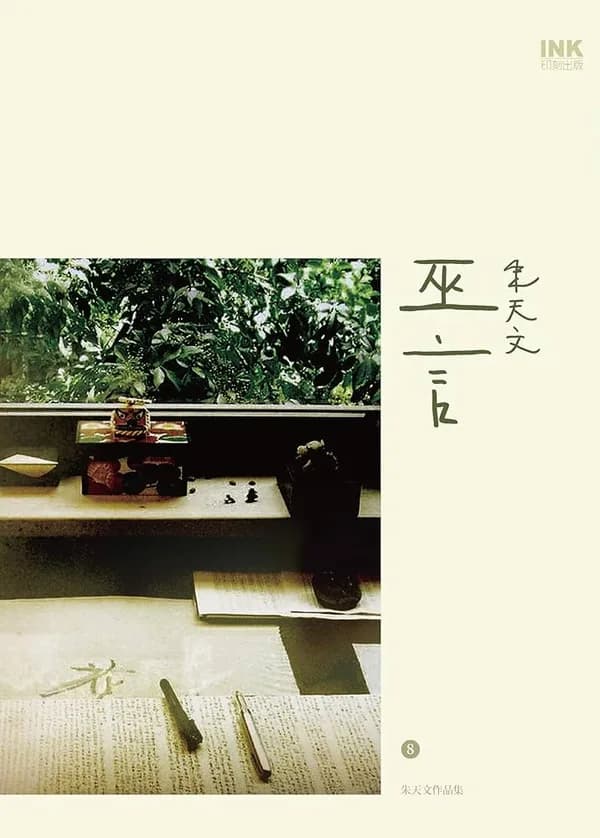
Wuyan
by Chu Tien-wen
Book Club Date:May 2025
📖 Book Summary
It took Chu T'ien-wen thirteen years to write this book. After *Notes of a Desolate Man* (荒人手記) in 1994, she fell almost silent for an entire generation, then in 2008 delivered *Witch's Brew* (巫言) — a novel that does not behave like a novel, a story that has no intention of telling a proper story. The "witch" (巫) is the book's central metaphor. The narrator is a female writer who is not so much living through a plot as *observing*: observing the everyday life of Taipei, the frenzy of elections, the textures of consumer society, and the subtle power dynamics between people. She is like a shaman, casting spells with language, weaving every fragment she sees into a dense, ornate, almost suffocating river of prose. There is no conventional storyline, no rising action or resolution, not even clear character development. It reads more like a prolonged drift of consciousness, fusing fiction, essay, cultural criticism, and private notebook into one. Reading it requires patience, but once you accept its rhythm, you realise Chu is doing something genuinely radical: she is asking whether, in a world that keeps accelerating and demanding efficiency and instant response, a writer can still use the slowest possible method to record the texture of an era, inch by inch. *Witch's Brew* won the Jury Award at the 2nd Hong Kong Baptist University Red Mansion Prize (紅樓夢獎).
✍️ Reading Notes
The biggest challenge of reading *Witch's Brew* is not that you cannot understand it, but that you have to abandon every expectation you bring to "reading a novel." There is no plot waiting for you, no character arc pulling you forward, not even a fixed narrative point of view. What you must do is follow Chu T'ien-wen's gaze — she sees something, you see it with her — and what she sees is always three layers deeper than you expected. Chu's prose style is pushed to its extreme in *Witch's Brew*. If *Fin-de-Siècle Splendour* was an ornate sprint and *Notes of a Desolate Man* a precisely paced middle distance, then *Witch's Brew* is an ultra-marathon with no finish line. Sentences can stretch so long you forget who the subject was; imagery can pack so densely you need to stop and catch your breath. But this is not showing off — at least that is not how I felt after finishing it. She is genuinely using the density of language to approximate the density of reality: this city, this era, these lives were never going to be captured in clean, concise sentences. Running beneath the surface is a thread about "the writer's position." The narrator keeps observing, keeps recording, but she knows full well that observation itself is a form of power and a form of alienation. She chooses to be the "witch" — not someone who participates in the world, but someone who names it. It reminded me of Walter Benjamin's flâneur: walking through the city, watching, collecting fragments, but never truly belonging anywhere. Chu's witch is a step more radical than the flâneur: she does not merely watch — she attempts to fix everything she has watched into language, turning it into a ritual against forgetting. What struck me most were the passages about Taiwan's election culture. The noise of campaign rallies, the hollowness of political language, the swelling and ebbing of crowd emotion — Chu records all of it with something close to an anthropological field-study gaze. You suddenly realise that literature can handle politics this way: not by taking sides, not by critiquing, but by treating it as a specimen of human behaviour and letting readers feel the absurdity for themselves. A final honest admission: this book is not for everyone. It demands that you slow down, accept uncertainty, and abandon the anxiety of "so what is it actually about?" But if you are willing, you will find a rare experience inside: someone spent thirteen years trying to capture the smell, the light, the noise, and the silence of an entire era — and fit it all into a single book.
💬 Discussion Points
- 1Chu T'ien-wen spent thirteen years writing one book. In an age that prizes speed, do you think 'slowness' itself can count as a creative stance? Is there anything in your own life you would be willing to spend that long completing?
- 2The narrator of *Witch's Brew* chooses to be an observer rather than a participant. Do you think a person in real life can simply observe without intervening? Is observation itself a form of intervention?
- 3The book uses an almost ethnographic approach to record election culture and consumer society. When literature handles political and social issues, which approach do you think hits readers harder — withholding judgment or explicit critique?