
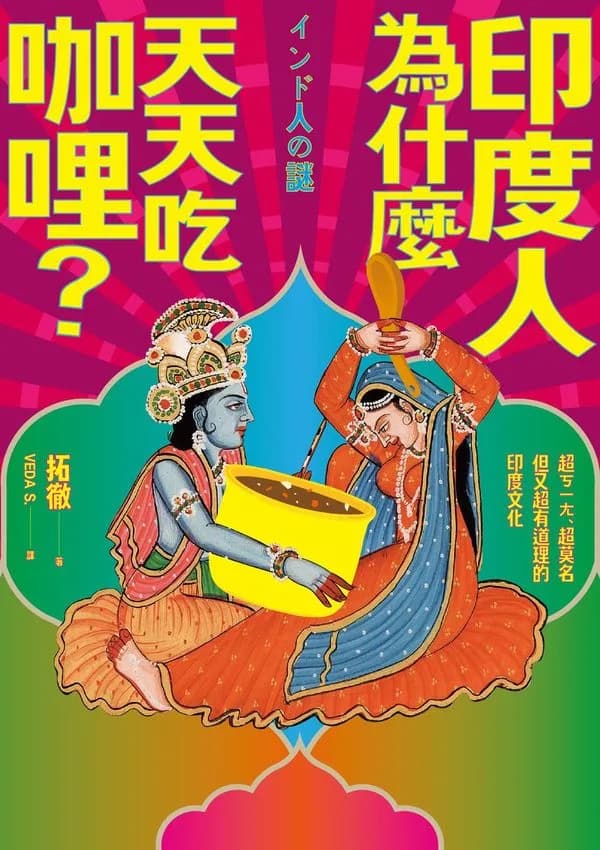
Why Indians Eat Curry Every Day
by Taku Toru
Book Club Date:July 2022
📖 Book Summary
*Why Do Indians Eat Curry Every Day?* is not really answering the "curry" question. Instead, it uses a string of everyday puzzles — the kind you cannot help wanting to ask but feel might be rude — to introduce how India actually works. The author is a Japanese cultural scholar who lived and studied in India for twelve years. Drawing on a sociological foundation, he unpacks each quirky question, slicing India into bite-sized "life topics": food, religion, caste, romance, slums, hygiene, language, English, identity … They look scattered, but by the end you realise they are all doing the same thing: pushing the "India myths" in our heads to the back and pulling the history and institutions that truly drive the society to the front. The book reads quickly, with a brisk pace; its aim is not exoticism but a distinctly Japanese combination of attentiveness and restraint, letting you understand differences without accidentally turning someone else's life into a joke.
✍️ Reading Notes
What I find most interesting about this book is that on the surface it answers tourist-brain questions like "do Indians really only eat curry," "why do the toilets look terrifying," and "does caste still exist" — but what it really wants to remind you of is: much of what we consider strange is not strange at all; it is simply "cultural difference" plus "long-term institutional accumulation." The "curry" question is the perfect example. Once you start digging, you discover that what you call *curry* is actually a lazy label the outside world stuck on India. Indian cuisine cannot possibly be reduced to a single dish — the north–south divide, staple-grain differences, spice logic, even what you think of as "the Indian flavour" may just be one region's taste that became the international stand-in. It is exactly like Taiwan being represented by xiaolongbao or Japan by sushi: convenient, sure, but it shrinks an entire culture into a single emoji. The book treats "caste" the same way. By the end you slowly understand that caste does not always appear in its most brutal, most dramatic form; it may hide inside marriage, employment, networks, geography, and family choices, becoming a social understanding of "everyone thinks we don't talk about it anymore, but it's still running the show." The author's greatest skill is that he does not lecture from above. He uses the feel of daily life to show you: when a society simultaneously carries colonial legacies, hierarchical structures, religious faith, and the anxiety of modernisation, it produces many fascinating "compromises." Something as mundane as toilet culture can tug out contradictions of identity and modernity — one side feels the Western way is more respectable, the other side's body habits lean toward squatting, and the result is a hybrid version you may not understand but which is perfectly logical. By the last page, I felt the book's real subject is not India — it is the way we look at the world: are you willing to trade "that's so weird" for "what's the context behind it"? Are you willing to admit that you, too, routinely use a stereotype to comprehend a vast place? What it trains is not India knowledge, but a rarer ability — understanding difference without letting the process be tainted by prejudice.
💬 Discussion Points
- 1If "India = curry" is a lazy shortcut, which country or city do you most often shortcut in the same way?
- 2When a society regards a certain lifestyle as more "advanced" or "respectable" but bodily habits and daily needs follow a different logic, what do you think happens in the end — gradual assimilation, or the emergence of more "hybrid" compromises?
- 3In your own life, is there a place where a similar contradiction plays out — where you know a certain choice is better for you, but habit, identity, or social expectations keep pulling you back to the original path?