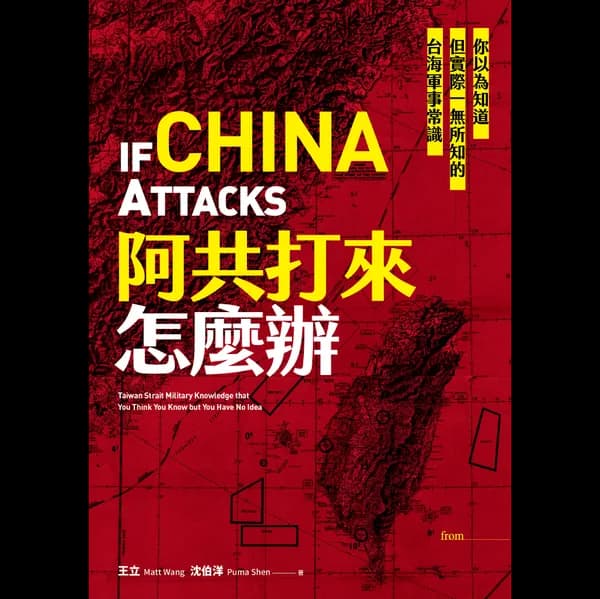
What If China Attacks
by Wang Li, Shen Bo-Yang
Book Club Date:April 2022
📖 Book Summary
*What If China Attacks?* takes a somewhat engineering-minded approach to disassembling the invasion scenarios, military myths, and information-warfare playbooks that have circulated over the past three decades. Which ones mythologise weapons? Which ones oversimplify war? Which are narratives designed to make you panic and feel that "resistance is futile anyway"? Authors Wang Li and Shen Bo-yang focus on "building basic military literacy and the ability to identify rumours," so readers can assess reality on a more grounded scale: aggression does not happen at the push of a button, and defence does not stand on a single slogan. If you want more after finishing, there is also a follow-up edition that brings in new post-Ukraine-war contexts (such as the broader use of information warfare and grey-zone tactics).
✍️ Reading Notes
The most valuable thing about this book is that it pulls "war" from the movies back to reality: war is not just missiles, beach landings, and urban combat — it also includes something far more mundane and far harder to defend against: making you give up on your own. The information-warfare logic described in the book is straightforward: rather than knocking you down, it is more effective to make you believe "resistance is pointless," to erode your trust in government, to make you doubt your allies, and to drain you with internal friction before a single shot is fired. In other words, the purpose of much fear-mongering is not "to provide intelligence" but "to shape emotions." You begin to understand why, in wartime, the most important thing is often not "what everyone knows" but "what everyone believes." So the book's myth-busting reads like training for a mental muscle: do not let the mythology of a single weapon lead you around, and do not let the fear of a single scenario hold you hostage. It keeps reinforcing one point: discussing military matters cannot stop at a weapons inventory — you must consider logistics, weather, political cost, time windows, and the costs the opponent has to bear. When you think of war as an enormously large, enormously complicated, enormously error-prone systems-engineering project, a lot of "instant-kill" and "one-wave wipeout" claims automatically lose their allure. But what struck me even more toward the end is this: the book is really a "military edition of media literacy." Because modern conflicts increasingly advance through a blend of truth and lies. In recent years, both Taiwanese officials and international media have noted that China's cognitive warfare operations against Taiwan have become more frequent, relying more heavily on social platforms, fake accounts, AI-generated content, and deepfake technology to package disputed narratives as something that "looks like public opinion." Bring the lens back to our own daily lives: the volume of information flowing through Taiwan is enormous. On a messaging app like LINE alone, the sheer throughput is staggering, and any content that "looks like something forwarded by a friend or relative" lands with built-in trust. In an information environment that dense, you can see why rumours never need to 100% convince you — they just need to introduce a tiny bit of uncertainty, a tiny bit of world-weariness, a tiny bit of "whatever, who cares," and they have already accomplished half their mission. That is why the book's approach — "first, dismantle the myth cleanly" — is really helping readers build a very practical skill: before fear arrives, see through its script. You will not necessarily become braver, but you will become considerably harder to drag away.
💬 Discussion Points
- 1What does "the most effective fear message" usually look like to you — scaring you with data, hooking you with conspiracy theories, or making you lie flat with "both sides are terrible, so why bother"?
- 2If you think of "resistance" as a form of social collaboration (not just military), what foundational infrastructure does Taiwan most need to shore up: media literacy, social-platform governance, community mutual aid, psychological resilience, or public communication?
- 3Can you recall a time when you almost forwarded a message that made you angry or scared, only to later discover it was problematic? In that moment, did you learn "how to fact-check" or "how to handle your own emotions"?