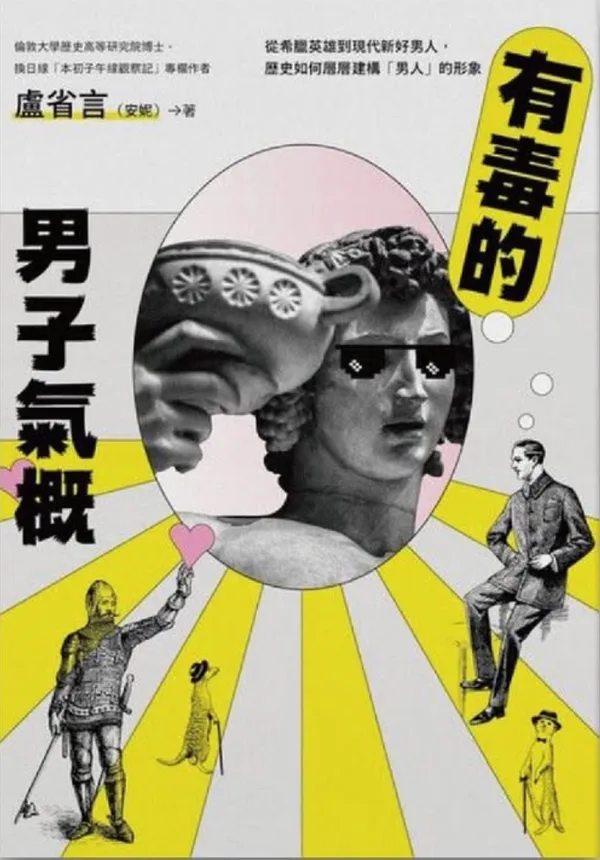
Toxic Masculinity
by Lu Sheng-Yan
Book Club Date:January 2023
📖 Book Summary
You can name a hundred reasons why "it's great to be a man" — political power, battlefield glory, no career interruption for childbirth. But can you articulate "why being a man is so exhausting"? *Toxic Masculinity* approaches the subject from a historian's perspective, dismantling the myth that "the rise of feminism inevitably suppresses men." It points to a cruel truth: the framework society imposes on "manliness" has never victimised only women. From the warriors of ancient Greece and Rome, to the celibate clergy of the Middle Ages, to the muscular labourers of the Industrial Revolution, the labels history piles onto men stack layer upon layer. In the modern era they have morphed into a high-difficulty survival game that demands you be academically outstanding yet tender, commanding yet sensitive. The book is structured like a "periodised history of male power and shackles": it walks us from the institutionalised making of Western knights all the way to the Eastern alternation between the domineering CEO and the gentle pretty-boy. By tracing how these "toxic" frameworks were produced, it aims to liberate men from historical servitude and redefine what true freedom means.
✍️ Reading Notes
Reading this book feels like a touring exhibition called "A History of Male Role-Playing." You thought masculinity was a stable personality, but it turns out to be more like a uniform — every era redesigns the cut. Antiquity demanded you be a fighter and an orator; the Middle Ages had one camp preaching that celibacy was sacred while another romanticised the knight's courage and loyalty; the Enlightenment began worshipping etiquette and social graces; industrialisation switched to admiring rugged muscles and self-reliance; wartime treated cowardice as "unfit to be a man." So the modern "good new man" becomes an impossibly long checklist: externally, grades, income, physique, and presentability; internally, emotional presence, high EQ, yet not too fragile. It looks like encouragement to improve, but it is really a demand to "play every version simultaneously." This is exactly what the term "toxic masculinity" is about: it does not mean men are toxic. It means certain celebrated male disciplines — suppressing emotion, treating dominance and violence as proof of manhood — harm both oneself and others. And its cruellest trick is that these disciplines are often packaged as virtues: endurance is called strength, not asking for help is called independence, not expressing feelings is called maturity. The end result is not stability but a state of perpetual, taut self-policing. Consider the Renaissance fashion of the "peascod belly" — men padded their abdomen to project an outline of power and maturity. Or black clothing in the early modern period, which gradually came to signify authority and gravity; the more restrained the attire, the more you looked like someone "worthy of dominance." Even "sexual potency" was hijacked by institutions and superstition to verify male credentials. In certain European texts and trial narratives, stories of the phallus being "stolen" or bewitched were essentially outsourcing male anxiety to a blameworthy target. If we do not dismantle these historically stacked frameworks, the modern "good new man" will live under ever-harsher scrutiny. True gender equality is not only about women's liberation — it is about letting men stop gasping for air inside that "toxic suit of armour."
💬 Discussion Points
- 1Which "masculinity KPI" has most often bound you in life? "Never show weakness," "be the one who carries," or "be the one who wins"?
- 2Do you think the "good new man checklist" is helping men improve, or is it stacking every era's demands into an impossible performance review?
- 3If "toxic" refers not to gender itself but to certain sanctified disciplines, which one do you think most urgently needs to be demystified? (e.g. emotional suppression, glorification of violence, the drive to dominate, the inability to ask for help)