
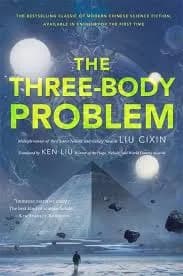
The Three-Body Problem (Trilogy)
by Liu Cixin
Book Club Date:March 2024
📖 Book Summary
*The Three-Body Problem* is the first installment of Liu Cixin's "Remembrance of Earth's Past" trilogy. Beginning with the trauma of the Cultural Revolution, elite scientist Ye Wenjie, working within a secret military project, sends a signal into the depths of the universe, opening the possibility of "receiving a reply" for humanity. Decades later, nanomaterials researcher Wang Miao is drawn into a mystery involving a string of scientist suicides and the "Frontiers of Science" organization. A virtual reality game called "Three Body" transforms the famous physics "three-body problem" into a civilization-level allegory: in a chaotic world with three suns, how do you survive? And how do you find meaning in being alive?
✍️ Reading Notes
Reading *The Three-Body Problem* feels like encountering a grand irony: humanity finally finds an alien civilization, and the first thought isn't "let's be friends" but "we're doomed." Because from the very beginning, the story frames "communication" as a weapon. Ye Wenjie's signal isn't the romantic gesture of a science nerd—it's more like a letter written in wounds, sent to the universe as witness. She doesn't simply want to be understood; she's more like asking: if humanity's cruelty is beyond redemption, does handing humanity over count as a form of justice? This approach of escalating personal trauma directly into civilizational destiny turns "first contact" from science fiction into an ethical bomb. Next, the novel transforms the "three-body problem" itself into a stunningly elegant metaphor. The world of three suns has no stable climate, no fixed order—civilization can only collapse and rebuild repeatedly during Chaotic Eras. This is actually smuggling in a far more brutal worldview: **instability is the norm; stability is the luxury.** As you watch Wang Miao trace the "Frontiers of Science," enter the "Three Body" game, and see the world's top minds realign their positions with near-religious fervor, you begin to realize: when people face a world spinning out of control, the first thing they seek isn't answers, but a narrative they can place themselves within. Then comes *The Dark Forest*'s most iconic stroke: the Dark Forest Theory. Luo Ji's hypothesis is fascinating not because "aliens are evil"—that would be too flat—but because it turns the universe into an extreme version of the security dilemma: you don't know whether the other side is benevolent, but the moment you reveal your position, you may be wiped out by a more advanced civilization in a single strike. This is nearly isomorphic with the "security dilemma" in international relations: you strengthen your defenses, others assume you're about to attack, everyone escalates, and ultimately no one is safe. Place it within the context of game theory, and it looks even more like the Prisoner's Dilemma: under conditions of no trust and asymmetric information, "striking first" appears rational, while cooperation seems naive. The Dark Forest Theory has also been compared to the Fermi Paradox: "If the universe is so vast, where are the aliens?" It offers a grim but plausible answer: perhaps everyone is hiding, because staying alive matters more than being understood. The Wallfacer Project then pushes this fear to humanity's last psychological line of defense: when the Trisolarans can use sophons to monitor information and disrupt fundamental science, the only thing humans have left is "thought"—temporarily unreadable. So they gamble their hope on "what's inside one person's mind." This setup is absurd enough to be funny, and modern enough to send chills: in our world, privacy has long been ground to dust by terms of service and data collection, and we routinely scroll to the bottom and click "I agree." *The Three-Body Problem* uses the Wallfacers to remind you: when everything is visible, the ultimate weapon isn't a bigger weapon—it's "invisibility" itself. Finally, in *Death's End* with the "dimensional reduction strike" and the two-dimensional foil, you suddenly grasp something: the terror of the universe isn't just firepower—it's that the rules themselves can be rewritten. You didn't lose because you didn't try hard enough; you were forced to play in an entirely different dimension. This is also where *The Three-Body Problem* most resembles a fable: using the hardest sci-fi shell to deliver the most human warning—don't be too confident, and don't be too loud, because you don't know how quiet the hunters in the forest are.
💬 Discussion Points
- 1If the "Dark Forest" is real, do you think humanity should choose silence, deterrence, or risk communication? What price would you be willing to pay to be "understood"?
- 2The Wallfacer Project stakes its hope on "thoughts being unmonitorable." In your own life, is there a domain that "can only stay inside your head" that represents your last piece of freedom?
- 3Do you think *The Three-Body Problem* is more about alien civilizations, or about humanity: when resources are scarce, information is opaque, and trust is absent, will we naturally gravitate toward confrontation?