
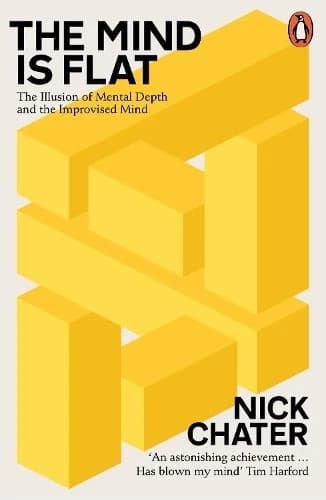
The Mind Is Flat
by Nick Chater
Book Club Date:June 2024
📖 Book Summary
*The Mind is Flat* is written by Nick Chater, a Fellow of the British Academy. Combining neuroscience, behavioral psychology, and perceptual psychology, he boldly proposes that the human mind is shallow. We've always assumed there are deep motivations behind our behavior, but through extensive experiments, Chater demonstrates that the brain is actually a "master of deceptive improvisation"—capturing fragmented information in the moment and instantly weaving together logical-sounding explanations based on past experience.
✍️ Reading Notes
The most cognitively challenging idea in this book is the "Illusion of Explanatory Depth." We often believe we understand how things work, but when asked to explain the mechanics of a toilet or a physical phenomenon, we discover our brains are full of gaps. This aligns with the concept in *The Knowledge Illusion*: humans are essentially a "knowledge community," frequently mistaking collective intelligence for personal understanding, thereby abandoning independent thought. This book goes further by pointing out that the reason our brains make us feel smart is entirely due to their powerful "bullshitting ability"—cobbling together a plausible-sounding narrative the instant a question arises. This "confabulation" ability is known in film as the **Kuleshov Effect**. When the same expressionless face is juxtaposed with "food" or a "coffin," audiences automatically attribute "hunger" or "grief" to the actor. This proves that our feelings don't stem from inner depth but from the brain's improvisational reading of "context." This also explains why modern reality TV can manipulate viewers' emotions through editing—what we see isn't genuine psychological depth but an illusion woven by editors exploiting the Kuleshov Effect. The most striking scientific evidence comes from "split-brain experiments" and the Left-Brain Interpreter. When the corpus callosum connecting the left and right brain is severed, the left brain (language center) has no idea what the right brain is seeing. Yet when the right brain directs the left hand to perform an action, the left brain fabricates a "completely wrong but extremely plausible" explanation without batting an eye. For example, seeing snow but claiming the shovel is for cleaning chicken droppings—this suggests our self-awareness may be nothing more than an "after-the-fact explainer," constantly interpreting behaviors that even it doesn't fully understand. This book upends conventional assumptions about psychology, and the author cites numerous experiments to support his claims. Although its ideas diverge significantly from common knowledge (such as the notion that depth of thought is an illusion, with most of it being the brain's improvisational patchwork), I find it quite fascinating. The book both challenges our cognition and encourages us to examine and compare various perspectives—making it an excellent workout for critical thinking.
💬 Discussion Points
- 1If your left brain is essentially a "professional screenwriter," constantly inventing excuses for your inexplicable actions (the Left-Brain Interpreter), would you still believe every decision you make is the product of "rational thought"? Have you ever had the experience of saying something, only to realize you were making it up—yet somehow managing to sound convincing?
- 2The Kuleshov Effect tells us that background and editing can completely alter our emotional judgment of a person. Does this make you start questioning the "personas" and "authenticity" you see on social media or reality TV? If your day were re-edited, what kind of new personality do you think your brain would piece together for you?
- 3Once we realize we're trapped in the "Illusion of Explanatory Depth" (thinking we understand how things work when we really don't), do you think this would make you more inclined to rely on "collective wisdom," or would it motivate you to dig deeper into the details and reclaim your sovereignty over independent thought?