
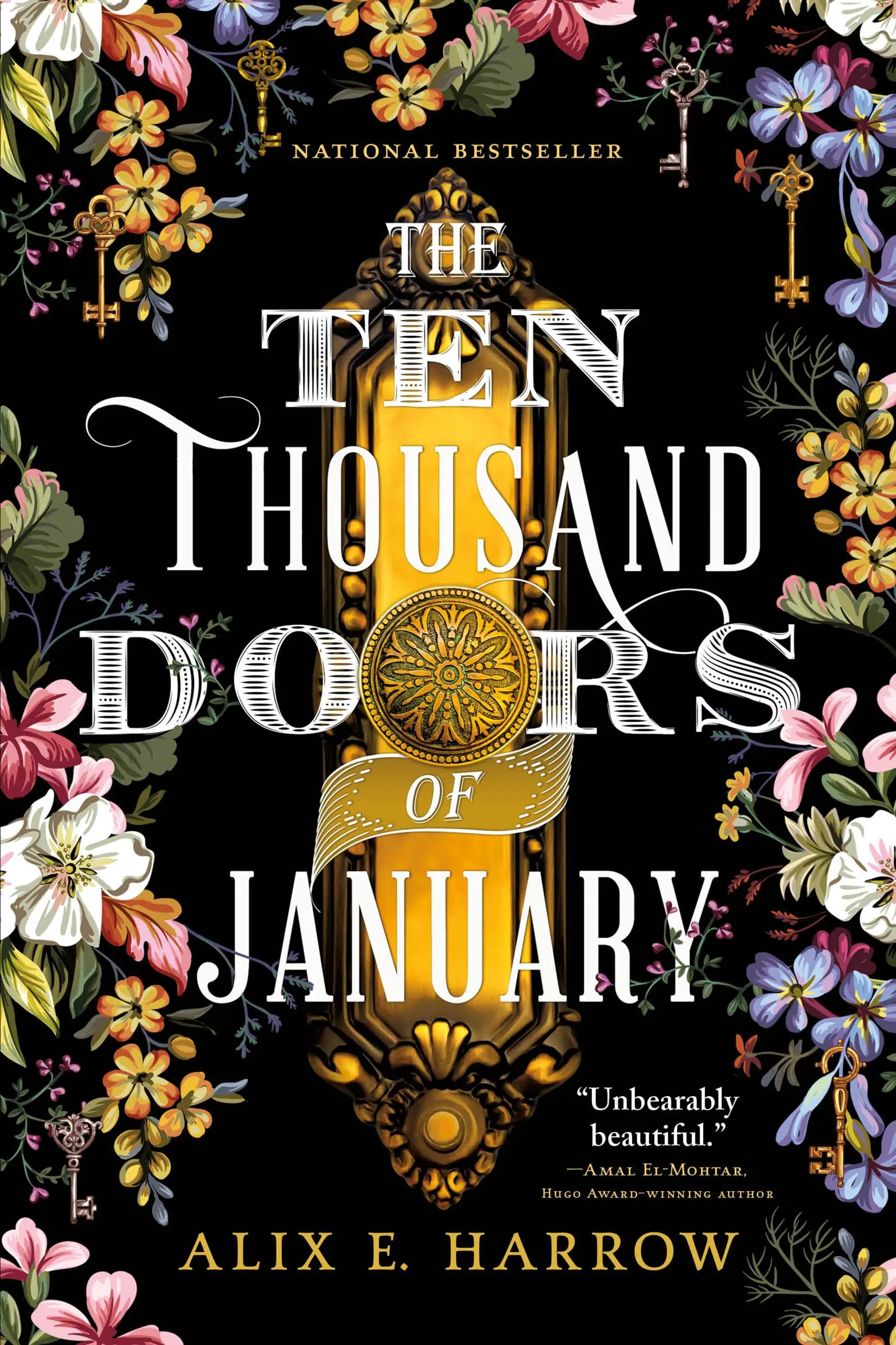
The Ten Thousand Doors of January
by Alix E. Harrow
Book Club Date:July 2023
📖 Book Summary
*The Ten Thousand Doors of January* is Alix E. Harrow's stunning debut novel. Before becoming a full-time writer, she was an academic historian specialising in African American history. That deep historical foundation lends the book a distinctive chapter structure — it mimics academic papers, using the tone of a researcher analysing source material and blurring the boundary between real and fictional. The story takes place in early 20th-century America, where a girl named January, with an unusual skin colour, grows up in Locke Manor. She is treated as the mansion's curator's prized curiosity, but when she stumbles upon a mysterious book about "Doors," she embarks on a journey across class, race, and time in search of her roots. The book's structure is a "story about stories" — it does not merely describe adventures across worlds; it asks **who holds the power to define reality**.
✍️ Reading Notes
The most gripping aspect of this book is how the author projects real-world secret societies into the fictional "Archaeological Society." When you see a group of powerful middle-aged men gathering in a room to chat, it carries the same air as real-world Rotary Clubs or Lions Clubs. The deeper reference is Freemasonry. From 18th-century craft guilds evolving into middle-class organisations influencing politics, such societies not only set industry standards but quietly shaped the struggle between American independence and the Crown. The Archaeological Society in the book is a miniature of how this "white-collar class with specialised expertise" tries to control world order — when these men gather, they are discussing not just small talk but how to maintain the status quo by controlling the "Doors." The story's backdrop is the twilight of the *Pax Britannica*, an era of extreme rationalist expansion. With steamships replacing sailing vessels during the Second Industrial Revolution, railways spanning Eurasia, and Edison and Rockefeller embodying machinery and wealth, the world seemed fully explicable. This is precisely the most dangerous moment for the fantastic: when science and reason become the only acceptable answer, all legends and magic are branded "feudal superstition" and forced to disappear. The closed or abandoned "Doors" in the book symbolise the sensibility and diverse possibilities erased by industrial civilisation. The protagonist's name, "January," is itself a massive piece of foreshadowing. It derives from Janus, the ancient Roman god who guards doorways and passages, his two faces looking at the past and the future. As the guardian of the new year, his image perfectly mirrors January's predicament: she is both an ancient artefact in Locke Manor and a pioneer opening the way to new worlds. This naming is not only a display of the author's historical literacy but reinforces the protagonist's destiny as a "bridge." Reading this book, you strongly feel an era's oppression come alive. Alix E. Harrow, with a historian's pen, meticulously renders the invisible shackles of skin colour and class. In that seemingly prosperous and progressive age, January's self-awareness as a "prized collectible" is the painful process of a marginalised group trying to reclaim a voice within the dominant narrative.
💬 Discussion Points
- 1In a relationship or a group, do you think "being cherished as a precious collectible" or "having the freedom to leave at any time" is closer to happiness? When Mr. Locke's "affection" for January is built on control and display, can it still be called love?
- 2In the book's age of rationalism, all things fantastical are slowly vanishing. Mapping this onto the modern digital era, when everything can be datafied, labelled, and explained by algorithms, which "Doors" in your life do you think are slowly being shut? Have you ever tried to find your own "blue Door"?
- 3If you joined a powerful society like the "Archaeological Society" or a real-world Freemasonry-like fraternity, with the power to covertly influence social order, would you choose to "guard order and maintain stability," or would you choose to "open all the Doors" so that forgotten stories can resurface?