
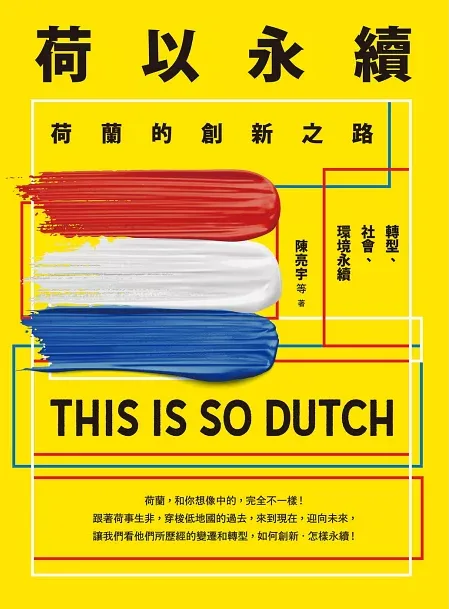
Sustainable Netherlands
by Chen Liang-Yu et al.
Book Club Date:July 2025
📖 Book Summary
*Sustainable Netherlands* is compiled by the "Holland Happening" team, deeply rooted in the country, and presents—across the dimensions of transition, society, and environment—the raw realities of Dutch transformation and challenges. This isn't just a book about environmentalism; it reads more like a diagnostic report on "systemic restructuring": from combating the resource-dependency trap known as "Dutch Disease," to redefining the relationship between consumers and manufacturers through the "circular economy," to honest self-examination of gender diversity and the predicaments of working women. The book's structure extends from the micro level of workplace culture all the way to the macro level of global trade history. It shows us the gray area of cannabis policy, the history of the Red Light District, and the rarely reported sports culture ingrained in Dutch DNA. It redefines what you might consider "added-value" sustainability as a systemic transformation requiring structural surgery—even changing the very DNA of consumption.
✍️ Reading Notes
The most thought-provoking argument in this book comes from architect Thomas Rau's proposal: "We should be buying services, not products." Under the current model, manufacturers shorten product lifespans for profit (planned obsolescence); but in a circular economy, if we're buying "illumination" rather than "light bulbs," or "refrigeration services" rather than "refrigerators," manufacturers are incentivized to maximize durability and recycling efficiency to minimize maintenance costs. This reversal—"taking responsibility for the product's entire lifecycle"—transforms a washing machine from a six-year disposable into an asset lasting fifteen years or more. This isn't just environmentalism; it's a fundamental provocation to capitalist logic. On the macroeconomic front, the so-called "Dutch Disease" serves as another profound warning. When a country earns massive foreign exchange from natural resources (like North Sea natural gas in the 1960s), causing currency appreciation and a loss of competitiveness in other manufacturing sectors, this "prosperity illusion" often plants the seeds of decline. The Netherlands later chose to combat this single-dependency risk by investing in green energy, the circular economy, and innovation. Compared to Taiwan's recent stellar performance in the electronics and ICT industry, while the central bank considers the two cases structurally different, the structural concern of "over-reliance on a single industry" remains a health check every modern nation must face. Furthermore, the book's demythologization of the "Golden Age" is critical. Although the 17th-century VOC was the world's first publicly traded company with an astounding market cap, its prosperity was accompanied by bloody massacres and slavery—including tragedies on Banda Island and Lamay Island. This reminds us: true "sustainability" cannot be built on the exploitation of others. Understanding this dark history enables the Netherlands to develop more inclusive social mechanisms when dealing with gender diversity, working women, and immigration. The book examines Dutch light and shadow across three dimensions—transitional, social, and environmental sustainability. Dutch workplace culture and treatment of gender diversity may not be as equal as assumed, and working women face their own challenges. It also covers a topic rarely reported in media—the Dutch's bone-deep sports culture. After reading, you'll learn: cannabis has always existed in a gray area? Can "Dutch Disease" be cured? The Netherlands has its own north-south rivalries? And the many histories of the Red Light District.
💬 Discussion Points
- 1Thomas Rau proposes "buying services instead of products" (like renting fridges, sofas, or even light). This is a huge shock to our ingrained notion of "ownership." For people studying abroad or living with frequent life changes, do you think this "rental model" is the optimal solution for reducing resource waste, or would it create an unsettling sense of "never truly owning your life"?
- 2"Dutch Disease" warns us of the risks of over-dependence on a single resource. While Taiwan's current industrial structure differs from the Netherlands of that era, how do you think we should avoid the crowding-out effect of "dominant industries" in the pursuit of economic growth, to achieve genuine industrial diversification?
- 3As we enjoy the progress of modern civilization, history reminds us that this prosperity may stem from past injustice (such as VOC's colonial wealth). How should a modern enterprise or nation handle this historical shadow when promoting "sustainability" and "brand marketing" in order to earn genuine moral respect?