
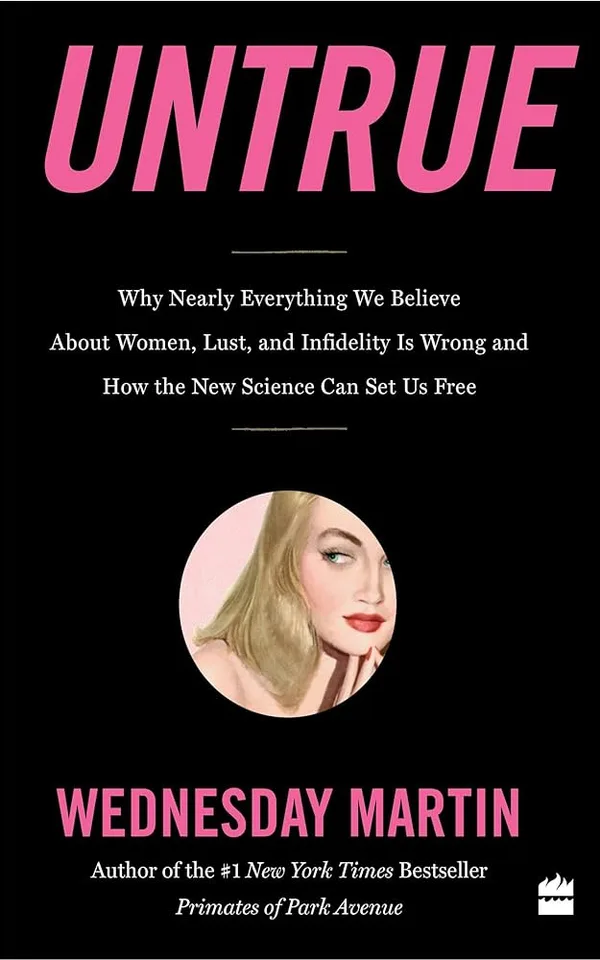
Untrue
by Wednesday Martin
Book Club Date:March 2021
📖 Book Summary
You can rattle off a hundred social excuses for why "men cheat and that is just how it is." But can you explain why a woman who wants more sex gets labelled abnormal, too needy, or too greedy? *Untrue: Why Nearly Everything We Believe About Women, Lust, and Infidelity Is Wrong* continues Wednesday Martin's sharp, funny, barbed observations from *Primates of Park Avenue*, except this time the lens points at a much more sensitive subject: female desire, female infidelity, and the whole package of "common sense" we use to explain them away. She walks into New York sex clubs and open-relationship workshops, interviews people who have experienced female infidelity from every angle, and stacks research from primatology, cultural anthropology, psychology, sexology, and sociology onto the same table, trying to answer the questions society loves to condemn but rarely bothers to understand: What kind of woman cheats? Why does she do it? How does she see herself? The book has an ambition to reset your defaults. It is not just about sex; it is about how institutions shape the way we imagine sex, love, and loyalty. From the mythology of monogamy, to the cost of divorce, from the property logic of agricultural societies, to how modern women's economic independence changes how desire is allowed to be spoken aloud. You think it is relationship gossip, but it keeps asking: are we choosing fidelity, or are we being forced into it?
✍️ Reading Notes
This book does not rush to defend "female affairs," nor does it rush to put anyone on a moral trial. It starts with something more uncomfortable: laying out the double standard on female desire for everyone to see. When men stray, it is described as instinct, impulse, a mistake but understandable; when women have desire, they risk being called insatiable, impure, unfit as partners. So many women's desires do not actually disappear — they are trained into silence: "don't say it," "don't think it," "better not even admit it to yourself." But the book also does not simplify the answer into "just try open relationships." What I saw instead was a very realistic contradiction: non-monogamy might stem from genuine needs, from wanting to keep a relationship alive, or from two people honestly admitting they cannot do the single-track thing forever. Recent research does show that in North America, roughly 3–7% of people are currently in consensually non-monogamous (CNM) relationships, and about one in five may have had such an experience at some point. That means it is not so niche as to be invisible, but nowhere near a cure-all either. You want freedom and safety. You want sparks and control. You want honesty, yet fear honesty could destroy everything. Eventually everyone in our reading group had the same realisation: "reasonable" is not a universal standard — it is whether two people can bear the consequences together and align their boundaries together. Then the book pulls back further and drops something even sharper: many people stay monogamous not because they naturally want only one person, but because the cost of leaving is too high — especially the financial cost. Divorce is expensive, and what you lose may not be just emotional; it can include children, reputation, resources, and future security. In many societies, women bear a heavier economic blow after divorce, so "choosing loyalty" sometimes looks more like risk management. The book also traces an interesting historical thread: how agriculture, property, and inheritance brought female sexuality and reproduction under a system of control and order, turning loyalty into morality and desire into stigma. Only after societies moved past agriculture, as women entered the workforce and gained economic and personal independence, did desire begin to be acknowledged — even renamed as "part of being human." After finishing the book, I felt its real argument is not "non-monogamy is the cure." It is "stop using one crude myth to explain everyone's desire." If a relationship lets two people live in a way that is comfortable for both, that kind of honesty and care may be closer to freedom than any relationship label.
💬 Discussion Points
- 1Where do you most often see the double standard between "male desire" and "female desire" in everyday language or situations?
- 2If non-monogamy is not about letting go but about high-level negotiation, whose feelings should the "rules" protect? Are the rules reducing harm, or just rationalising anxiety?
- 3When "divorce is expensive" becomes the invisible premise, can loyalty still count as a free choice? If you factor in financial security, caregiving duties, and social judgment, how would you redefine a fair relationship?