
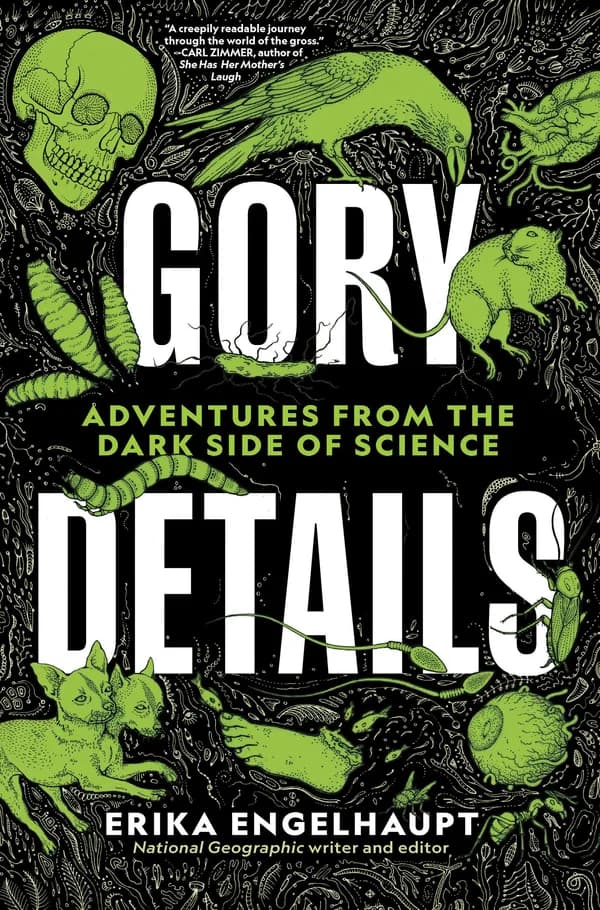
Gory Details
by Erika Engelhaupt
Book Club Date:July 2021
📖 Book Summary
Have you ever felt a contradictory kind of curiosity — you know something bloody, disgusting, or taboo is "not really something you should look at," yet your finger keeps scrolling? *Gory Details* opens a safe room for exactly that impulse. Its goal is not shock value; it is to drag the things we are too embarrassed to ask about — and too nervous to think through — under the light of science for a close-up look. Author Erika Engelhaupt is a science journalist and the writer behind National Geographic's "Gory Details" column. She covers autopsies, forensics, insects, psychology, and human taboos in a style that is both rigorous and funny, making you wince and nod at the same time — and eventually admire just how bizarre human research can get. Reading the book feels like a cross between a curiosity cabinet and a forensic crime scene. Each chapter stands on its own; you can start with the topic that scares you most and quickly discover: some things are terrifying not because they truly matter, but because we are too used to sealing them away with fear.
✍️ Reading Notes
The scariest moments in *Gory Details* often are not the corpses or bloodstains. They are the small things you assumed were just background noise, which turn out to be the variables that tip the truth. Take the flies buzzing around a crime scene: you might think they are just disgusting extras, but in forensic science they are living carriers that can physically move evidence. Scientists ran an experiment that sounds like a prank but is entirely serious: they let blowflies contact human blood, semen, saliva, and other body fluids, then analysed the flies' excreta and regurgitation for recoverable human DNA. The results were startling — the traces flies left behind could indeed yield complete or partial human DNA profiles, and detection rates were especially high under semen-related conditions. Even more absurdly, the human DNA could still be detected after extended periods, on the scale of hundreds of days. That single cut punctures the romance of modern forensics: DNA is not an oracle; it is a "highly sensitive but highly fragile" clue. As detection technology becomes ever more refined, even the tiniest transfer can be amplified into a story. That is when you suddenly understand why the book keeps emphasising the value of "looking at taboos through science": horror does not always originate from evil — it originates from the complexity of systems. You may have committed no crime and still get pulled into a narrative you never wanted, because of the environment, insects, transport, and misreading. But the same fact has another face: if insects can carry evidence away, they can also leave new trails at a silent scene. The creature you thought was merely revolting might turn out to be a witness to time, contact, and movement. It was only at this point that I realised what *Gory Details* really wants you to practise is not courage, but a more mature curiosity: the things we fear are often frightening only because they have been wrapped in "don't talk about it." But once you dare to step closer, fear starts to decompose into understandable mechanisms, traceable details, and clearer judgment. If the world really has ghosts, perhaps they are not spirits — but the details we dismissed as "unimportant," quietly pushing the truth in another direction.
💬 Discussion Points
- 1What is the "taboo topic" you most want to look at but are least willing to admit you want to see? Do you think your sense of disgust is protecting you, or limiting you?
- 2Are you more afraid of "government surveillance" — that grand kind of power — or of "forensic evidence possibly rewritten by a single fly" — that tiny but lethal kind of chance?
- 3When science starts explaining taboos, do you think it is eliminating fear, or making the world even more unsettling? Would you rather know the truth, or keep your distance?