
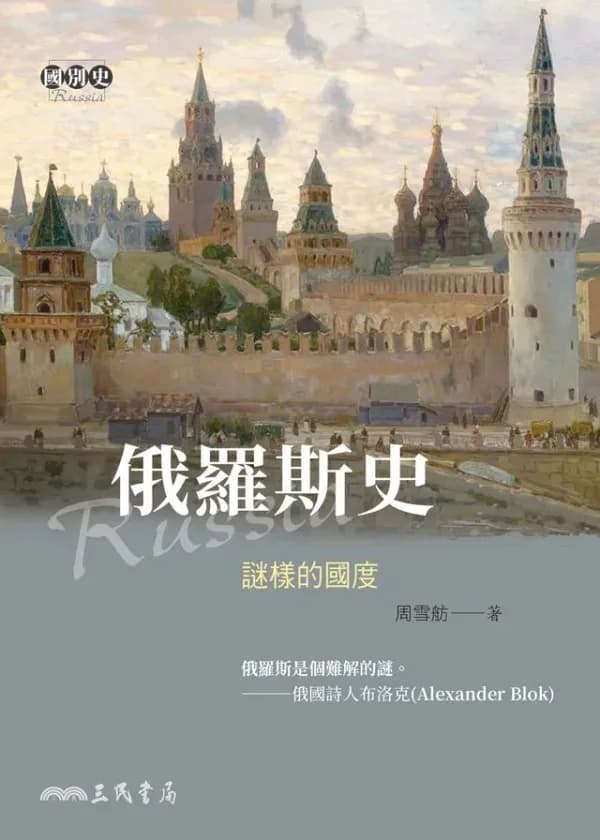
Russian History
by Chou Hsueh-Fang
Book Club Date:June 2025
📖 Book Summary
*A History of Russia: The Enigmatic Nation* (Sanmin Books, 5th revised edition) is a general history of Russia written by Zhou Xuefang in a style attuned to Taiwanese readers. Starting from Kievan Rus in 862, it traces forward to the late 20th century, with the new edition adding analytical essays and afterwords on the Putin era and the Russia-Ukraine war—making it not just "ancient history" but a resource for understanding the deep causes behind contemporary controversies. Zhou Xuefang is a retired professor from the Department of History at Fu Jen Catholic University, a long-time specialist in Russian history, whose writing is clear, smooth, and accessible, while preserving sufficient historical complexity.
✍️ Reading Notes
Russia was born on the East European Plain—terrain so flat it's almost monotonous—where a sense of security was naturally scarce. This meant the state easily prioritized security as its highest value; over time, it developed a kind of political muscle memory: when chaos strikes, centralize power; when threats loom, become more autocratic. This rhythm of "the state surviving on tension" would later permeate imperial governance, social hierarchy, and even the temperament of literature. Kievan Rus was never a pure national fairy tale from the start—it was the product of trade routes, armed merchants, and power alliances. As noted in historical overviews, the Varangians established outposts along rivers, forming the trade artery "from the Varangians to the Greeks" and spurring urban development. This route brought Russia close to Byzantium, and its religion (Eastern Orthodoxy), writing system (Cyrillic), and architectural styles were long influenced—planting the seed of Russia's identity struggle: "wanting to be European, yet refusing to be merely European." Moving to Ivan III and the subsequent centralization and strengthening of tsarist power, I see it as the gradual crystallization of Russia's "governance solution": a vast nation, low density, many external threats, great internal diversity—the most expedient (and most dangerous) approach was to turn society into a controllable machine. Serfdom kept production running; noble service obligations bound the upper class to the state; reform and modernization were often squeezed into a framework of "not breaking the autocratic skeleton." You grasp the structural tragedy: the empire is enormous, but the space where freedom can operate is tiny. Over time, broad innovation and reform energy become nearly impossible to generate—the nation increasingly resembles a giant ship, driven forward by inertia, and returning to old paths by inertia as well. Finally, pulling into the 20th century—the Russo-Japanese War, 1905, the February Revolution, the October Revolution, the Soviet Union, the post-collapse Yeltsin era, and the Putin period—the whole stretch reads like repeated confirmation of one sentence: Russia frequently gets pulled back by a stronger "craving for order" after "brief moments of openness." This is why, when we see the 2014 Crimea incident or the full-scale Russian invasion of Ukraine on February 24, 2022 on the news, it's easy to treat it as geopolitical spectacle. But through the "long lens of history," it looks more like an old problem erupting in a new century: security, imperial logic, identity anxiety, and distrust of the outside world—mixed together, they become a situation that can't be settled in a single day's news cycle.
💬 Discussion Points
- 1Do you think "Russia gravitating toward tradition/autocracy at historical crossroads" is more like geographic destiny, institutional inertia, or a survival strategy forced by external threats?
- 2If you read Russian history as a "history of the search for security," which period best illustrates how far Russia is willing to sacrifice for the sake of safety?
- 3After reading this book, which lens would you be most inclined to use for understanding the Russia-Ukraine conflict: leadership decisions, national narrative, imperial logic, or "long-term historical habits"?