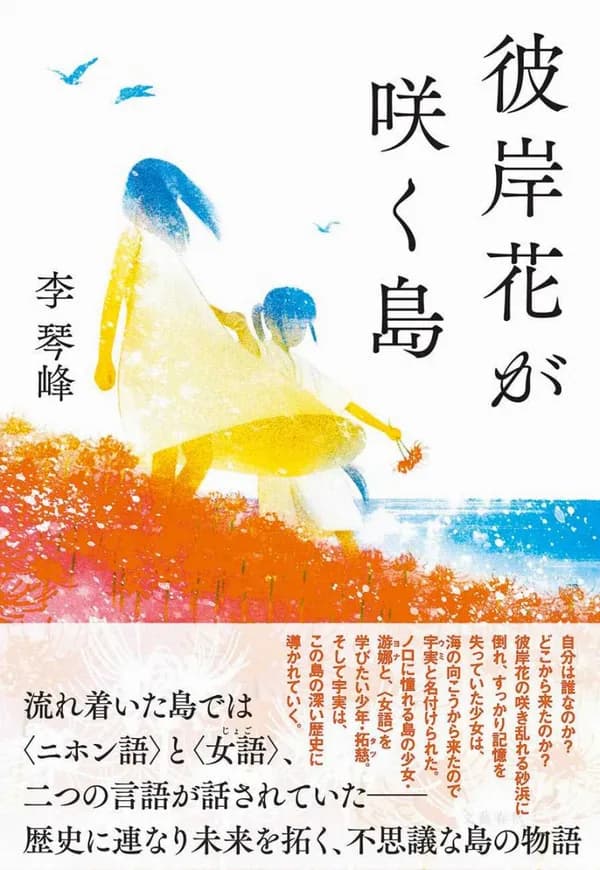
彼岸花が咲く島
by Li Kotomi
Book Club Date:February 2023
📖 Book Summary
You can name a hundred reasons why "history is written by men" — for war, for power, for defining orthodoxy. But have you ever imagined what the world would look like if history were built on "women's logic" and an "exclusive language"? *The Island Where the Spider Lilies Bloom* (彼岸花盛開之島) is Li Kotomi's crowning achievement, winner of the 165th Akutagawa Prize. As the first Taiwanese writer to receive the award, she writes in Japanese — not her mother tongue — giving her a more detached and perceptive vantage point for "language experiments." The story is set on an island where spider lilies bloom year-round. A girl named Umi drifts ashore; to become an islander she must learn "Jogo" (the women's language), mastered only by women, and become "Noro," a priestess charged with carrying history. Meanwhile, a boy her age named Takuji secretly studies Jogo, because he cannot understand why "learning a language" should be a gender-restricted zone. The structure blends Western "utopia" with Eastern "Peach Blossom Spring" imagery and folds in legends from the Ryukyu Islands and Yonaguni. This is not merely a fantasy fable; it is a bold social experiment incorporating critiques of pandemic, war, and xenophobia. By imagining an island ruled by women under a political system entirely unlike our own, it redefines the historical perspective we take for granted.
✍️ Reading Notes
The most striking feature of this book is the "depth" of its language. The island's tongue is not pure Japanese but a hybrid forged from multiple cultural traces. It reminded me of the powerful Haitian Creole in the game *Cyberpunk 2077*. In reality, Haitian Creole was born when linguistically diverse West African slaves, stranded on an island, fused African grammar with French vocabulary to survive. Just like the "Jogo" that Umi must learn, language is not merely a communication tool — it is a **boundary of identity**. When the boy Takuji tries to cross the gender taboo and learn Jogo, he is challenging not just language, but the island's entrenched power structure. The book's depiction of "utopia" also carries sharp metaphor. The author drew inspiration from Copenhagen's "Christiania" free town — a self-proclaimed autonomous enclave sealed off from the outside world. On the island there is no traditional concept of family; women collectively raise children. It looks perfect, yet shadows exist. Like the spider lily itself, which is both anaesthetic and sellable narcotic, the island excludes men from power and religious institutions — raising the question of whether this is just another form of discrimination. After reading, we also noticed some points worth debating. To foreground her themes, the author sometimes simplifies characters: women tend to symbolise gentleness and reason, while men are often cast as emblems of violence and negativity. Moreover, the book offers little concrete description of resource distribution or economic systems inside the utopia. But that may be precisely the nature of allegorical fiction: it does not give answers — it throws out questions. Under Li Kotomi's tender yet incisive pen, we witness the chemical reactions of queer theory, feminism, and social institutions inside an island laboratory. This island is both ideal and mirror. It reflects how deeply the science, politics, and ideologies constructed by men are rooted in our real world — so deeply that we need fiction this extreme just to glimpse another possible way of living.
💬 Discussion Points
- 1If a society decreed that "only one gender may learn the language that records history," would you view it as a necessary protection or another form of monopoly?
- 2Can you accept that the "cost of utopia" is excluding certain people from the core of power? Where should the boundary of an ideal community be drawn?
- 3In your own life, is there a "Jogo"-style language barrier — such as academic jargon, workplace slang, English proficiency, or a particular circle's mode of expression? Whom does it protect, and whom does it exclude?