
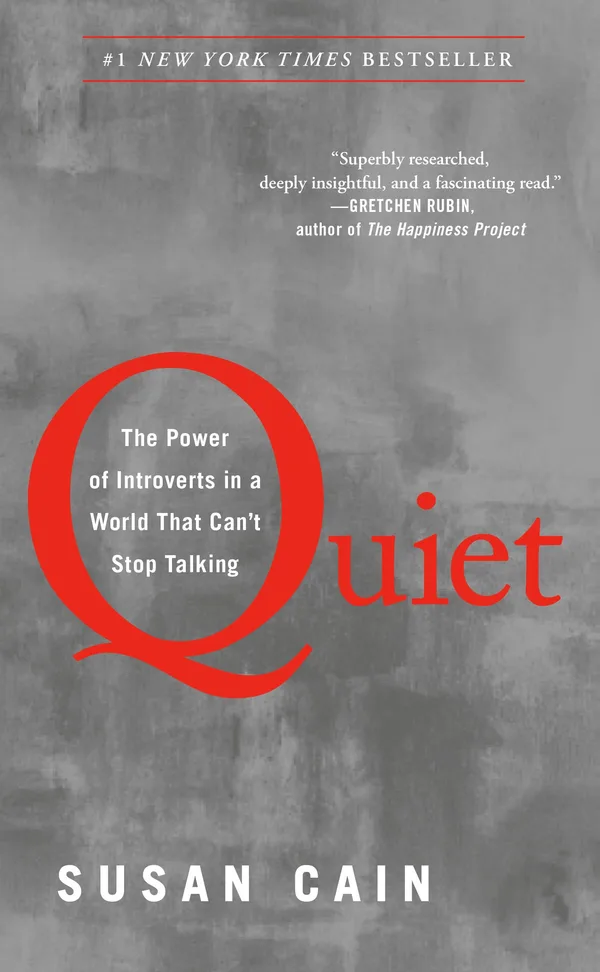
Quiet: The Power of Introverts
by Susan Cain
Book Club Date:September 2021
📖 Book Summary
If you have ever had your brain freeze at the words "let's do a quick brainstorm," or left a party feeling like a phone at 1% battery, you are probably not "bad at socialising" — you just recharge differently from the world's default setting. *Quiet: The Power of Introverts in a World That Can't Stop Talking* is Susan Cain's 2012 open love letter to "the quiet ones," and also a reminder to society at large: we are so used to worshipping the extroverted style that we have made "speaks up, takes charge, brings the energy" the default template for success — while overlooking a very different kind of power that comes from quietness. The book smartly reframes introversion and extroversion from "personality labels" back to "stimulus preferences": introverts typically prefer lower stimulation and need solitude to recharge; extroverts draw energy more easily from socialising and high stimulation. Cain also stresses that introversion is not the same as shyness — shyness is more about fear of being judged, while introversion is a configuration of energy and stimulus. Even more interesting, she pulls the lens back to cultural history: how American society shifted from a "Culture of Character" that valued discipline and integrity, to a "Culture of Personality" that rewards performance, charisma, and stage presence — making the "Extrovert Ideal" the mainstream script we chase without even realising it.
✍️ Reading Notes
The gentlest yet most cutting subtext of *Quiet* is this: you are not inadequate — you have just been placed at a volume that does not suit you. From Jung's original framing of introversion and extroversion in *Psychological Types* (where he saw it as a fundamental way of understanding whether attention is directed outward or inward), to modern psychology's more concrete description of it as "a difference in stimulus preference," the book keeps doing one thing: unwrapping the misunderstandings we hold about introverts. What struck me most was Cain's depiction of the social pressure to be "witty, sparkly, lovable." When the whole world rewards the loud, quiet people easily misread themselves as needing to be fixed. But the book reminds us: quiet people are often better at deep thinking, finer observation, and more careful risk assessment. This is not romanticising introversion — it is placing it back into a framework of diversity: the world inherently needs different operating modes, or only one voice ends up steering the direction. Then there is the question everyone wants to ask: is personality fixed? Can you be "introverted one second, extroverted the next"? The research threads cited in the book are clear: temperament shows signs very early. Developmental psychology studies found that infants who react more strongly to unfamiliar stimuli — the "high-reactive" babies — are more likely to display inhibited, cautious behaviour later on; neuroimaging research also suggests that people with this "inhibited temperament" may show stronger amygdala responses to novel stimuli. But that is not destiny. A more realistic way to put it: you may have a default setting, but you can learn to adjust the dial. Practising social skills, creating manageable exposure situations, finding your own rhythm — you can become more capable in crowds when you need to, while preserving the way you actually recharge. What the book most wants to protect is not "introverts should never change," but "don't force yourself to live in a way that doesn't fit." I loved how the book reframes "being alone." Many people equate "working solo" with "how sad," but solitude does not necessarily equal loneliness. Through the lens of arousal theory, each person's optimal level of stimulation differs; introverts often need lower-stimulus spaces to enter focus, flow, and deep practice. In other words, when you think someone is "lonely," they may actually be "quietly levelling up." The most encouraging line in the book is probably this: introverts do not have to turn into the extrovert on stage and can still become people who change the world. Gandhi is cited as an example of someone quiet yet tremendously powerful in articulating values. That kind of power does not come from noise — it comes from clarity. So after finishing *Quiet*, what I actually want to redefine is "confidence": I know how I operate, and I am willing to do things as that version of myself. It is not that you need confidence before you can build ability — you build ability, and confidence grows from there.
💬 Discussion Points
- 1In which situations do you most often feel "overstimulated" (meetings, parties, group chats)? How do you usually recharge?
- 2Have you ever mistaken "introversion" for "incapability"?
- 3If teams, classrooms, or communities always reward "the best speaker," how might we redesign systems so that "the best thinker" can also be heard?