
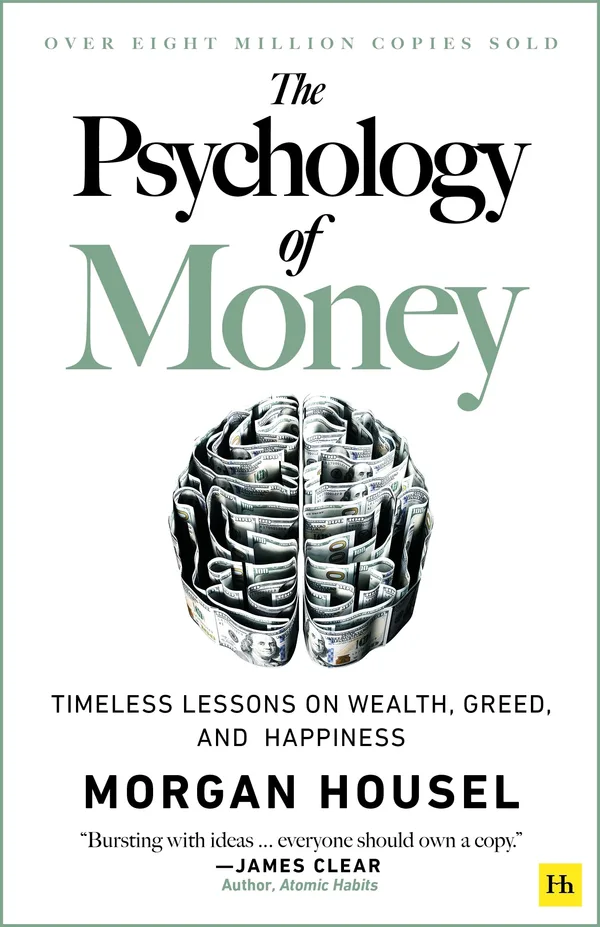
The Psychology of Money
by Morgan Housel
Book Club Date:June 2021
📖 Book Summary
Imagine yourself carrying a Chanel bag, wearing Armani, sitting in a Ferrari. What you are probably thinking is not "I am so happy," but "will people think I am successful?" Now switch the angle: you are sitting in a café, watching a Ferrari roar past. You rarely think "that person is cool." You are more likely thinking "if I were driving that car, people would think I am cool too." That is the magic trick *The Psychology of Money* wants to expose: what we chase is often not wealth itself, but a script written for other people's eyes. Author Morgan Housel uses a series of short stories to show that the hard part of money is not "can you calculate a rate of return" — it is "how do humans make decisions." Because money decisions are never made inside a calculator. They are made at the dinner table, in the boardroom, inside your childhood memories and your self-esteem. So rather than a financial how-to, this book builds a more durable worldview about wealth.
✍️ Reading Notes
I think *The Psychology of Money* works best as a mirror — not reflecting your portfolio, but the part of you that wants to be seen. Housel shares his time as a parking valet, watching supercars roll in and out. He knew the admiring glances were rarely aimed at the driver; people were running an internal script: "if I were in that car, how would people look at me?" That pivot is brutal but clarifying. A lot of spending is not about happiness; it is about being liked. The problem is that the feedback loop of being liked is usually short, while the price tag can stretch very long. The book also splits "getting rich" into two distinct skills: making money and keeping money. The first often relies on boldness, risk-taking, and seizing the moment; the second relies more on restraint, margin of safety, and not getting wiped out by the urge to go all-in. Housel keeps circling back to "survival": you do not need to be right every time; you need to avoid a single mistake that takes you out of the game permanently. Some bets, no matter how high the potential return, are not worth staking your life on, because you cannot afford the worst-case outcome. Then there is compounding and the long tail. The book keeps reminding you that wealth does not come from being brilliant every day; it comes from a few correct calls plus a long stretch of not doing anything stupid. Compounding's most practical demand is not intelligence — it is time. The long tail's most uncomfortable truth is that you have to accept that most of your efforts will look ordinary, right up until a key moment suddenly amplifies everything. This also connects to his definition of "time dividend": one of money's deepest intrinsic values is giving you more control over your own time. What I liked most is his insistence on "enough." Many people are perfectly capable of making money; they just do not know when to stop. You can always have a little more, but if you never define what "enough" looks like, you will be pushed endlessly by comparison, vanity, and fear. You look wealthy on the outside while feeling permanently poor on the inside. Housel's conclusion (admittedly a bit like a life motto) is: real financial freedom is usually not a number on a statement — it is whether you can trade less anxiety for a more stable life.
💬 Discussion Points
- 1Have you ever bought something and later realised you were really buying other people's approval?
- 2If you had to write down your own definition of "I already have enough," what would it say?
- 3What risks in your life are "not worth it no matter how high the return"?