They Know Everything About You
by Robert Scheer
Book Club Date:April 2021
📖 Book Summary
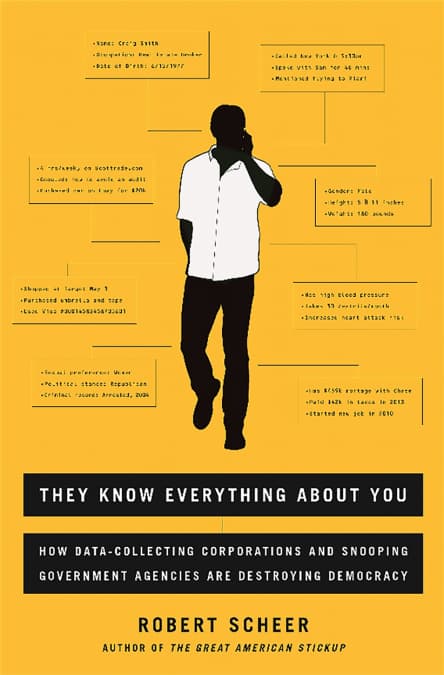
Have you ever wondered what the battlefield looks like when the government says "this is war"? Not swords, guns, or rockets aimed at the moon — but the binary world inside the cloud. Whoever controls the airspace between 0 and 1 holds the greatest power in the modern world. *They Know Everything About You* is written by veteran journalist Robert Scheer. The subtitle says it plainly: data-collecting corporations and a snooping government are steadily undermining democracy. The book reads like a user manual for the surveillance era, pulling two threads onto the same map: one is how tech companies turn our browsing, location, preferences, and social behaviour into tradeable personal profiles; the other is how governments, under the language of national security and counter-terrorism, have let surveillance expand into a norm. It is not a lifestyle guide telling you to delete all your apps. It forces you to face a harder truth: when you are recorded and profiled on an ongoing, indiscriminate basis, privacy is no longer about "whether I have secrets" — it is about "how much freedom I have left."
✍️ Reading Notes
"This is war — at least that is what the government says." War has always been technology's most powerful accelerant, and when the battlefield moves to the cloud, the centre of gravity quietly shifts from invention to surveillance. Not because every engineer wants to play the villain, but because "seeing more clearly" is always justified in a wartime frame. But does justified really equal legitimate? After Snowden exposed mass surveillance, the British government used legal pressure to demand *The Guardian* destroy the hard drives and devices containing the files — carried out under GCHQ personnel's direct supervision. You suddenly realise that when "getting close to the truth" itself is treated as a threat, it is often the whistleblower and the messenger who get punished, not the surveillance apparatus. Even more chilling, Snowden was never talking about a handful of targeted individuals; he was talking about ordinary people swept into systematic collection. So the question becomes: is privacy the minimum threshold of freedom? If people in a society know they could be recorded, cross-referenced, and filed at any moment, they become more cautious, quieter, and less willing to challenge power. That is not conspiracy theory; it is human nature. The most powerful thing about surveillance is not that it catches you doing something wrong — it is that it makes you start deleting certain thoughts in advance. Even more modern and harder to defend against: platforms can manipulate emotions. In 2014, Facebook's research team altered the content mix in News Feeds for nearly 690,000 users in an "emotional contagion" test. When positive content was reduced, users posted fewer positive words and more negative ones, and vice versa. The publication sparked massive backlash because, for the first time, people saw in concrete terms: you think you are using the platform, but you may also be the platform's lab material. Are platforms like Facebook "information channels" or "information editors"? Because they do not just decide what you see — through ranking and exposure, they can quietly shift your current mood, even indirectly shape your behaviour. If one day the manipulation targets not mood but voting intent, group polarisation, and social division, that is no longer just a privacy issue — it is public life being rewritten. Does Europe's stricter stance on privacy mean it will fall behind the US and China in the tech race? That is one of the book's core tensions. The tighter the privacy rules, the harder it is to brute-force innovation with data; the looser they are, the faster products get smarter, but people become more transparent faster too. The question has never been which side to pick, but whether we are willing to admit: this is a trade-off that needs to be publicly discussed and institutionally negotiated, not quietly decided for us by platforms and governments. After finishing *They Know Everything About You*, what I want to take away is not panic, but a harder question: how much of your life are you willing to hand over to invisible systems to arrange?
💬 Discussion Points
- 1When governments justify surveillance with "national security," where do you think the acceptable boundary lies?
- 2Are you actually more worried about "the platform deciding what you see" than about government surveillance? If a platform is simultaneously an information editor, an emotion lab, and a behaviour guide, how should we demand it be held accountable?
- 3Do you think privacy and technological development are necessarily a zero-sum game? If you had to balance "speed of innovation" with "personal freedom," what would the most reasonable trade-off look like?