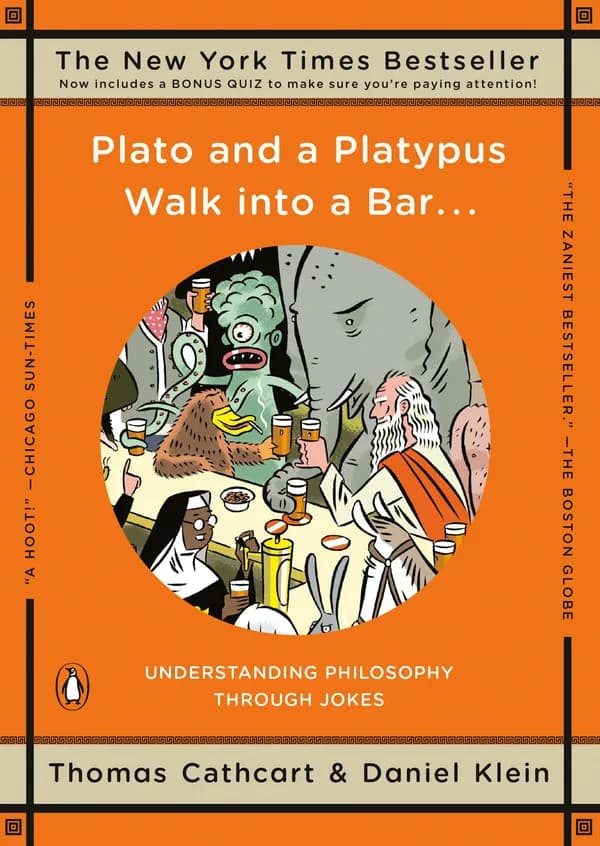
Plato and a Platypus Walk into a Bar
by Thomas Cathcart, Daniel Klein
Book Club Date:December 2022
📖 Book Summary
You can name a hundred reasons why "philosophy is boring": the theories are too abstruse, the names too hard to remember, the required reading never-ending tomes. But can you name a reason why "philosophy and jokes" are actually twins? *Plato and a Platypus Walk into a Bar* is the work of two not-so-disciplined Harvard philosophy graduates, Thomas Cathcart and Daniel Klein. They realised that what philosophers call an "insight" is what comedians call a "punchline twist." The book reads less like a serious textbook and more like an open-mic night at a bar, pouring ten unavoidable topics in Western philosophy — from metaphysics and logic to existentialism and meta-philosophy — into joke-shaped bottles. The structure is extremely clever: the authors know that philosophy and comedy each have their own logical systems. Through brilliant arrangement, they let you have an "aha" moment right in the middle of a laugh. This is not just a philosophy primer; it is a love letter to the power of critical thinking.
✍️ Reading Notes
The most charming thing about this book is how it uses "un-serious" jokes to dissect the "most serious" issues. Take the famous "bachelor's bride selection" joke: three women present warmth, beauty, and wealth respectively, but the man picks "the one with the biggest breasts." It is not merely a dirty joke — it is a thought exercise on **value judgement and pluralism**. We habitually use social criteria (virtue, economic power) to evaluate the "legitimacy" of a choice, but everyone, shaped by different backgrounds, holds different values. This "to each their own" ending actually embodies one of modern egalitarianism's key principles: diversity — the freedom to choose. When the discussion extends to "Soviet jokes," the book leads us into Marx's **dialectical materialism**. Soviet jokes are funny because they embody the three laws of dialectics: things necessarily have two sides, quality and quantity transform into each other, and negation is itself negated. The people living under the Soviet system — half hoping it would collapse, half unable to see any hope — used jokes to process the contradictions and absurdities of reality. That humour is not mere foolery; it is the most profound form of "dissolving" power and the system. Interestingly, the authors also touch on evolutionary theory and "survival of the fittest." We often assume the survivors are the strongest, but evolution is frequently the product of environment and a chain of "coincidences." It is like choosing your Pokémon starter: many people pick Squirtle to beat the first gym, only to discover later that Charmander is stronger in the long run. This "promising beginning, uncertain end" regret illustrates that the world often cannot produce an "optimal solution" — many excellent beings vanish simply because they could not withstand a violent coincidence or an environmental shift. Finally, the book touches on "meta-jokes." The "meta" here means "about X itself." When a joke references the joke form, or we become aware of the process of our own cognition, we transcend the content. This meta-thinking makes readers realise that philosophy is not only studying the world — it is studying "how we study the world."
💬 Discussion Points
- 1Do you think an "offensive joke" can be a good philosophical starting point? Should the line be drawn at "content" or at "power dynamics"?
- 2If a joke's function is to make people see contradictions, what was the last thing that made you "laugh and then feel a twinge of guilt"?
- 3Which serious field would you most like to teach as a "bar stand-up class": politics, economics, gender studies, history — or your own romantic history?