
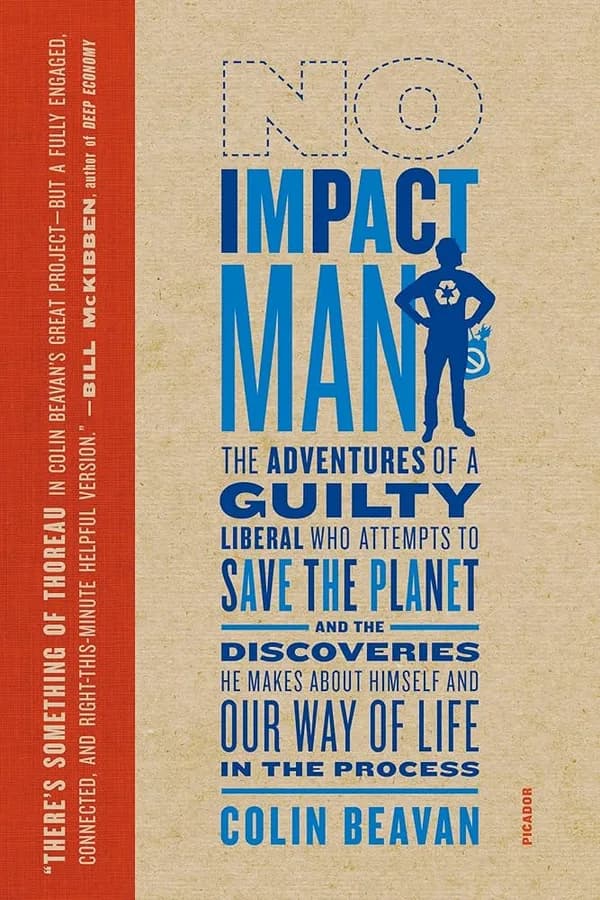
No Impact Man
by Colin Beavan
Book Club Date:January 2024
📖 Book Summary
*No Impact Man* isn't about "you should try harder to save the planet." It's about an ordinary middle-aged man living in New York, **Colin Beavan**, who suddenly decides to bring his wife, their one-year-old diaper-wearing daughter, and a dog along for a full year of "No Impact" living: no producing trash, no toilet paper, no elevators, no TV, no cars—even attempting to live without conventional electricity and switching to lower-impact alternatives. The most ironic part is the result: his health improved, his marriage gained breathing room, and life actually felt more like *living*. Instead of guilt-tripping you with alarming statistics, the book uses a series of awkward yet hilarious everyday moments to help you see that "going green" might not mean more suffering, but rather more clarity.
✍️ Reading Notes
The most captivating aspect of this book is how it drags "sustainability" down from the pedestal and places it right next to the kitchen, bathroom, and trash can. Colin wasn't some eco-hero at the start—he was even confused about whether paper bags or plastic bags were better. But once he actually began his "do no harm to the planet" experiment, he discovered that the hardest part of environmentalism was never the technology but the psychology: you have to admit that most of the conveniences you're accustomed to aren't necessities—they're anesthetics. Toilet paper, takeaway cups, elevators, instant entertainment—each one whispers, "You deserve the easy way," but after taking the easy way long enough, you start forgetting what it means to care. On the surface, this book is about "zero-waste living," but at its core, it's about "zero-autopilot living": you have to start making deliberate choices again. When they stopped watching TV, used less electricity, and lit candles at night, what they unexpectedly gained wasn't asceticism but more genuine connection and focus (and, of course, more opportunities for arguments). When they switched to bikes and scooters, losing weight was just a side effect—the real change was that they began to re-perceive the city, distances, time, and how much energy they were spending on "unnecessary movement." However, the gentlest yet most annoying thing about *No Impact Man* is this: even after the experiment ended, Colin still felt guilty about taking taxis and elevators, because a sense of "the right way to live" had already taken root in his mind. This reminds me of something: environmentalism sometimes isn't moral progress—it's a new form of OCD. What the book truly pushes you toward isn't becoming a perfect person, but becoming someone more willing to honestly face what they care about—to spend your time, money, and attention on the people and things that matter, instead of being led around by convenience.
💬 Discussion Points
- 1If you were to try a "won't-kill-you" eco-experiment (not a whole year—maybe just two weeks), which habit would you want to cut first: takeout and packaging, transportation, electricity use, or screen time?
- 2Does "environmentalism" feel more like "freedom" to you (making more conscious choices), or more like "a new guilt system" (feeling bad when you fall short)?
- 3If "going green" is really about redistributing attention, which conveniences would you be willing to move back to the "occasional use only" category in exchange for more time, better health, or stronger relationships? (For example: less binge-watching for more sleep, less driving for more walking, less eating out for more cooking together.)