
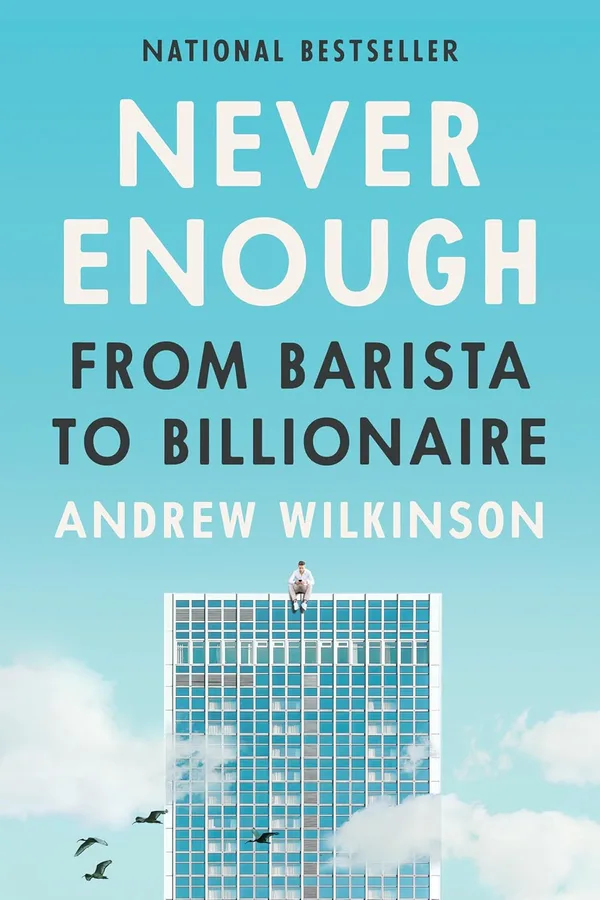
Never Enough
by Andrew Wilkinson
Book Club Date:September 2024
📖 Book Summary
You can name a hundred reasons for "wanting to get rich": buying a supercar, living in a mansion, achieving financial freedom, making everyone who once looked down on you eat their words. But can you explain where that bottomless emptiness and anxiety come from "after you actually have a hundred million dollars"? *Never Enough: From Barista to Billionaire* is the autobiographical confession of tech legend and MetaLab founder Andrew Wilkinson. He launched his business at 25, was worth over $100 million by 37, with clients including YouTube, Slack, and Shopify, and even earned the admiration of Warren Buffett's partner Charlie Munger. But his journey from barista to billionaire wasn't all glamorous acquisitions—far more of it was about childhood deprivation, the gamble of "fake it till you make it," and a reorientation of life's meaning after a conversation with Buffett. The book's structure reads like an "anatomy class of money psychology," from the pressure of the wealth gap experienced in a school district to the personal threats and loneliness that come with fame. This isn't just about how to get rich—it redefines what you thought was the "finish line" of wealth as a "demon" that needs to be mastered, and even reconciled with.
✍️ Reading Notes
Wilkinson's drive to build wealth was actually buried deep in a childhood that left him feeling suffocated. For the sake of a good school district, his parents took on a mortgage far beyond their means, which made him acutely aware of "the shame of poverty" at a young age, surrounded by luxury cars and designer labels. This "sense of scarcity" became the fuel for his later entrepreneurship—running websites at 14, asking Steve Jobs a question at 15—all driven by the same thought: I need to make big money to solve all my problems. This psychology also spawned MetaLab's early "fake it till you make it" strategy. He posted photos of designer friends on the website, pretending to be a large team, and coined the professional term "interface design company" to raise his profile. While this led to rapid success, it also planted the seeds of anxiety. The 2008 financial crisis made him see clearly: if wealth is merely about compensating for past deprivation (buying PlayStations, eating expensive meals), it's nothing but a fragile illusion in the face of crisis. When wealth actually accumulated past the hundred-million mark, the real test began. Wilkinson discovered that the joy from private jets and five-star suites was extremely fleeting, followed by "the loneliness of the rich." He worried about being seen as a show-off if he picked up the tab, or being called stingy if he didn't. He was surrounded by fair-weather friends and even faced intruders at his home. This is the book's central exploration: more money often doesn't mean fewer worries—it amplifies the black hole within. Ultimately, in a conversation with Warren Buffett, he found a new perspective. Buffett only invests in businesses with a "moat," and Wilkinson applied this logic to acquiring brands like AeroPress. He realized that rather than endlessly chasing numbers, it's better to find "moat businesses" with long-term competitive advantages that he genuinely loves. He eventually signed the Giving Pledge, committing to donate at least half his wealth. This wasn't a display of moral superiority but a final reconciliation with his demons—acknowledging that he doesn't need to own so much in order to truly possess freedom.
💬 Discussion Points
- 1Wilkinson's drive for wealth stemmed from childhood fear of the wealth gap and a desire for "revenge." Looking back at your own desire for success, does that drive come from a passion for "creating," or from some kind of "unwillingness to accept" or compensation for a "sense of scarcity"?
- 2In entrepreneurship or the workplace, have you ever used the "fake it till you make it" strategy to survive? As you "performed" more and more like a successful person, did you feel growing confidence or a deeper Impostor Syndrome?
- 3Buffett's "economic moat" theory protects businesses, but if you apply this concept to "personal growth" or "lifestyle," which of your current skills or traits do you think is the hardest for others to breach—the "moat" that gives you the greatest long-term sense of security?