Manufacturing Truth
by Liu Chih-Hsin
Book Club Date:September 2022
📖 Book Summary
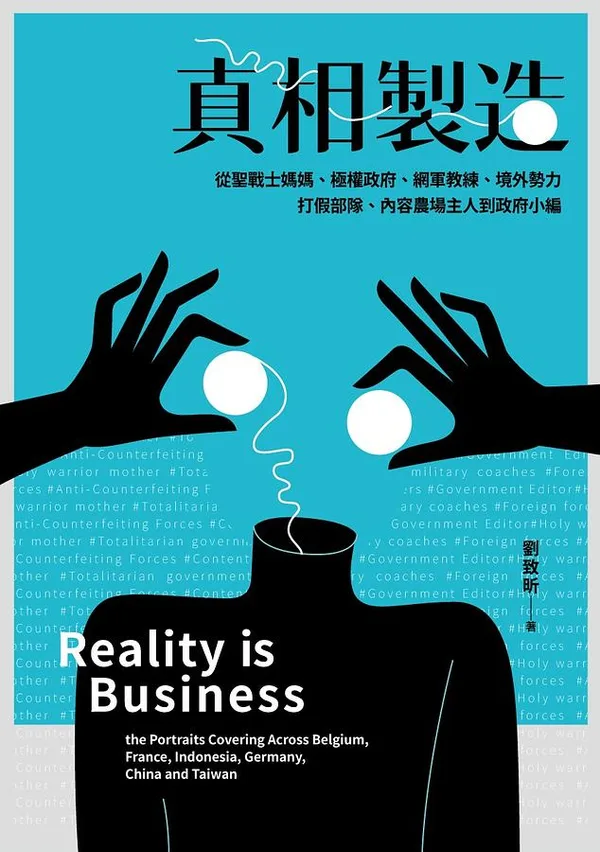
Author Liu Chih-hsin is deputy editor-in-chief at *The Reporter*, a journalist, and a podcast host. Starting from Brussels in 2016, beginning with an interview of a heartbroken but undefeated mother of a jihadist, he travels across Belgium, France, Indonesia, Germany, China, and Taiwan. What he offers is not just first-hand reporting but, most preciously, the people in each story. His pages hold no absolutely good heroes or purely evil villains: there are people consumed by their circumstances, people who rise to fight back, and people who spot an opportunity for profit and fan the flames. Living inside the vortex of the information-explosion era, the book invites us to find a Taiwanese lens through which to examine, compare, and ultimately guard against the "fake-news" wars. We appreciate how the author opens with a wide-angle view from other countries before slowly pulling the camera in, leading us from the international predicament to Taiwan's own homegrown crisis.
✍️ Reading Notes
We think we are scrolling through our phones to see the world, but *Reality is Business* is more of a reminder that the world is also using the same algorithms and emotion factories to "read" us. The book pulls "fake news" back from a throwaway insult into a full-fledged supply chain: platform engagement rewards, politicians' mobilisation rhetoric, media's speed anxiety, and that tiny ego inside everyone that craves proof that "I'm the one who is truly awake." Liu walks with a journalist's body, trades interviews for perspective, and from Brussels in 2016 crosses into Belgium, France, Indonesia, Germany, China, and Taiwan, pointing the camera at "people" rather than "positions": someone grieves yet refuses to despair, someone is consumed and then fights back, someone smells arbitrage and keeps stoking the fire. It reads less like a "how to spot disinformation" manual and more like an anthropological field recording, letting you watch how reality is manufactured, packaged, distributed, and finally swallowed whole by us — while we still call it independent thinking. What I like about it is that it does not rush to hand out hero and villain badges. The people in the book are mostly not clean, nor entirely hateful; more often they are simply "pushed along" — by unemployment, fear, humiliation, identity anxiety — until at some junction they grasp a narrative that makes them feel better, even if that narrative is hurting someone else. You begin to understand that the most powerful thing about information warfare is usually not how well it fabricates, but how well it "pours into the hole already in your heart," leading you to mistake anger for justice, forwarding for participation, and picking a side for holding a value. When the author finally swings the camera back to Taiwan, a prickly familiarity sets in: many things that "look like they're just arguments" are actually testing whether a society can share a minimum viable reality — whether, before splitting apart, people can first agree that they still live in the same world. After finishing *Reality is Business*, I actually want to treat "slowness" as a civic muscle exercise: a bit slower to conclude, a bit slower to forward, a bit slower to label the other person as beyond dialogue. Because in the attention economy, the fastest is usually not the truest, and the most thrilling is usually not the most important.
💬 Discussion Points
- 1Do you think the scariest thing about "fake news" is fabricated content, or its ability to make us lose the capacity to share reality?
- 2If "forwarding" is a form of power, what minimum responsibilities should we bear each time we press the share button?
- 3At what point does platform governance (reduced reach, takedowns, ad transparency, researcher data access) cross the line into "censorship" that makes you uncomfortable?