
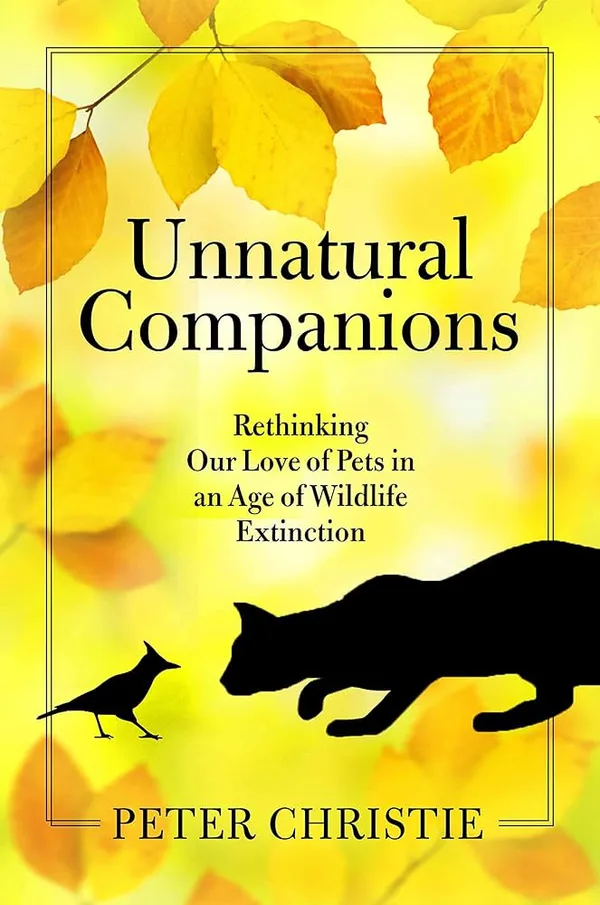
Unnatural Companions
by Peter Christie
Book Club Date:February 2022
📖 Book Summary
Have you noticed that our love for companion animals is often riddled with contradictions? We will post frantically about a lost cat, yet in the same city quietly accept that certain birds and small animals are becoming rarer. *Unnatural Companions: Rethinking Our Love of Pets in an Age of Wildlife Extinction* starts from that prickly paradox and forces us to confront an unromantic question: when "I love it so much" becomes a lifestyle, could that love also be causing harm somewhere else? Author Peter Christie is a science journalist and a dog owner. Through interviews and scientific data, he takes us on a "global tour of the pet world," putting things we normally do not want on the same table: the impact of free-roaming and stray animals on wildlife, invasive species and disease risks, the supply chain of the exotic pet market, and how the pet industry (including feed and consumer culture) has become part of the conservation crisis. The book's power is not in telling you to suddenly become "anti-pet." It is in asking you to upgrade your love to a more reality-aware version: not just hugs and healing, but also boundaries, responsibility, and whether you are willing to change a few very ordinary habits for the sake of lives you cannot see.
✍️ Reading Notes
What I appreciate about this book is a core provocation: it is not attacking "love" — it is asking "could the way you love happen to be part of the problem?" Our feelings for animals are genuine, so genuine that we even coined a term for the health benefits animals bring us — *zooeyia* — meaning roughly "positive health effects humans gain from interacting with animals." But place that same love inside an ecosystem and it gets very complicated: the more you treat a certain species as family, the more likely you are to unknowingly turn it into another species' nemesis. The hardest and most unavoidable case in the book is usually cats. In our culture, cats are too harmless, too cute, too much the embodiment of a "free spirit that doesn't need managing." But from a conservation standpoint, free-roaming domestic and feral cats are a significant global predation pressure. Research compilations indicate that cats are linked to the extinction of at least 63 species, and recent global analyses show that cats prey on over two thousand species, many of which are conservation-listed. This is not saying "cats are evil." It is saying: once we release them into the wild, they will diligently do what they are naturally built to do — and they are extraordinarily efficient at it. So the seemingly two-sided debate over "should we feed strays" often jams on a larger knot: where exactly do we place companion animals? As family members, or as invasive predators in an ecosystem? Both descriptions may be simultaneously true. The book also discusses the axolotl, which is wildly popular in the global pet trade and research world, projecting an almost "cute enough to be immortal" illusion. Yet in the wild, its situation is dire — listed as Critically Endangered by the IUCN, hammered by habitat pollution, urban expansion, and invasive fish, with wild populations in continued decline. This "thriving in tanks, vanishing in the wild" conservation paradox forces you to rethink what extinction means: sometimes it does not mean "completely gone from Earth" — it means "in the world it originally belonged to, it is no longer itself." But I also do not want to read this book as "humans don't deserve pets." I see it as teaching a more mature form of love: you can acknowledge that pets truly heal and truly matter (in some contexts, therapy animals have become an expected source of comfort), while also honestly facing the fact that healing does not equal absolution, and that many seemingly warm practices, without institutional and scientific support, can turn into another form of self-congratulation. The real difficulty is not "to love or not" — it is "are you willing to turn love into a way of living that can be implemented, examined, and corrected."
💬 Discussion Points
- 1Can you accept requiring house cats to stay indoors (or at least be equipped with restrictions) in order to protect wildlife? Where do you think the line should be drawn to be fair?
- 2When "animal welfare" and "biodiversity" conflict, which side does your instinct lean toward?
- 3If you treat "love" as a choice that comes with costs, where would you be willing to start adjusting — such as how you keep pets, whether you buy exotic animals, feed choices, spaying and adoption, or supporting conservation-friendly policies?