
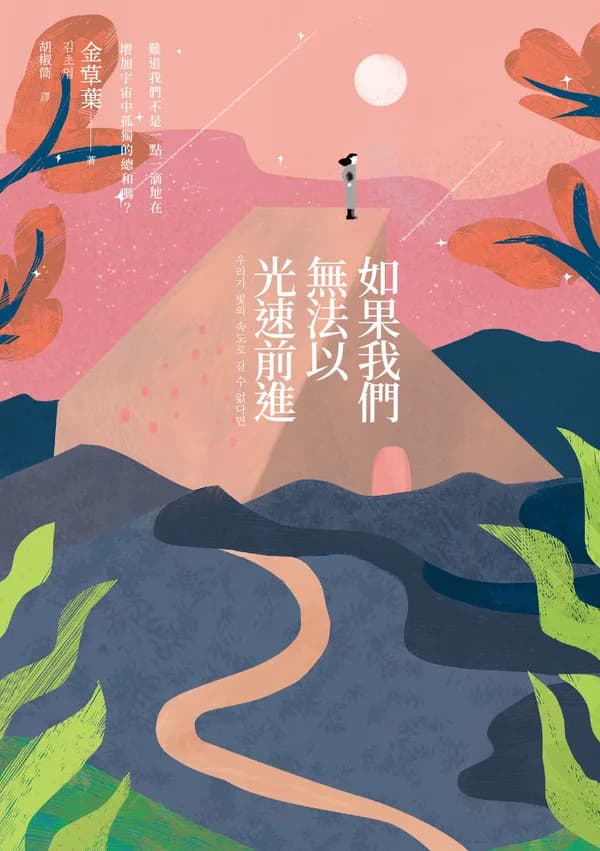
If We Could Not Travel at the Speed of Light
by Kim Cho-yeop
Book Club Date:May 2023
📖 Book Summary
*If We Cannot Travel at the Speed of Light* is a short-story collection by Kim Cho-yeop, a rising Korean science-fiction writer. Its seven stories appear to be about space, alien life, mind-uploading, cryogenic freezing, and cosmic pioneering, but underneath they are all writing about the same thing: we want to be understood. Many readers call it "warm sci-fi" — not because the world is gentle, but because the author places tenderness in humanity's most vulnerable moments. Kim Cho-yeop (born 1993) comes from a science-and-engineering background, having studied at POSTECH. She gained recognition in Korean science-literature awards with "Lost in the Museum" and the title story, and the collection sparked wide discussion upon publication in Korea.
✍️ Reading Notes
The most powerful thing about this book is that it deliberately avoids the "hero-saves-the-world" goosebumps and instead uses very everyday aches — waiting in vain, being unable to speak, failing to understand, arriving too late. Science fiction here is no longer fireworks; it is a toolbox. The author places future technology in front of her characters and asks a cruel question: if you really could upload your mind, really could reach a more distant universe, really could communicate across species — what would you most want to fix? Many would assume the answer is fate, the world, grand history. But Kim's characters usually just want something smaller, more personal: a belated moment of understanding, a self that is no longer misunderstood, a relationship that gets a proper goodbye. "Lost in the Museum" features the seemingly cool premise of uploading minds after death, yet it lands on a profoundly human dilemma: a lost person is not just dead — they may also be "lost" inside the system. A daughter searching for her mother's data in a cosmic-scale library finds herself searching, increasingly, for years of unspoken resentment and love. What truly moves is not how powerful the technology is, but that it gives the character a path toward possible reconciliation — showing you that the hardest part of any relationship was never the answer, but whether you are willing to try to understand again. "Spectrum" pushes "communication" to its extreme: languages do not match, species differ, even the way life perpetuates itself is different. The "Louis" beings that Heejeong meets replace themselves generation after generation, passing memory through images and records. You suddenly realise: humans have always treated "being able to talk" as the ticket to understanding, but real understanding often happens beyond words — in whether you are willing to see the other's rhythm, fear, goodwill, and clumsy effort. When Heejeong later returns to Earth to study colour-language, it is as if she turns that untranslatable coexistence into a lifelong research question. It made me think: bridging difference is not finally "hearing" what the other says, but admitting "I don't understand" — and refusing to give up getting closer. The title story, "If We Cannot Travel at the Speed of Light," captures the cruelty that technological progress can deliver. When faster "wormhole tunnels" replace old "warp engines," galaxies not on any wormhole route become islands forgotten by technology. Researcher Anna, determined to reach a galaxy with no wormhole link — but where her kin live — is willing to pilot an ancient ship that may never arrive. That irrational devotion is precisely the "residual warmth of humanity" that technology cannot calculate. As Kim Cho-yeop herself has said: "No matter where I live or which generation I belong to, I don't want to give up on mutual understanding." Whether humans end up uploaded to the cloud or adrift on alien worlds, loneliness follows like a shadow. But it is precisely these efforts to cross the speed-of-light barrier and the boundary between life and death that give the cold universe its warmth.
💬 Discussion Points
- 1If the future really allowed "mind-uploading" or "memory reconstruction," would you most want to repair a relationship or a version of yourself?
- 2Do you believe "understanding always requires language"? In your life, is there a relationship that was actually held together by presence, gesture, and unspoken rapport?
- 3What is truly frightening about distance — the physical remoteness, or the kind where you are in the same universe yet can never reach each other again?