
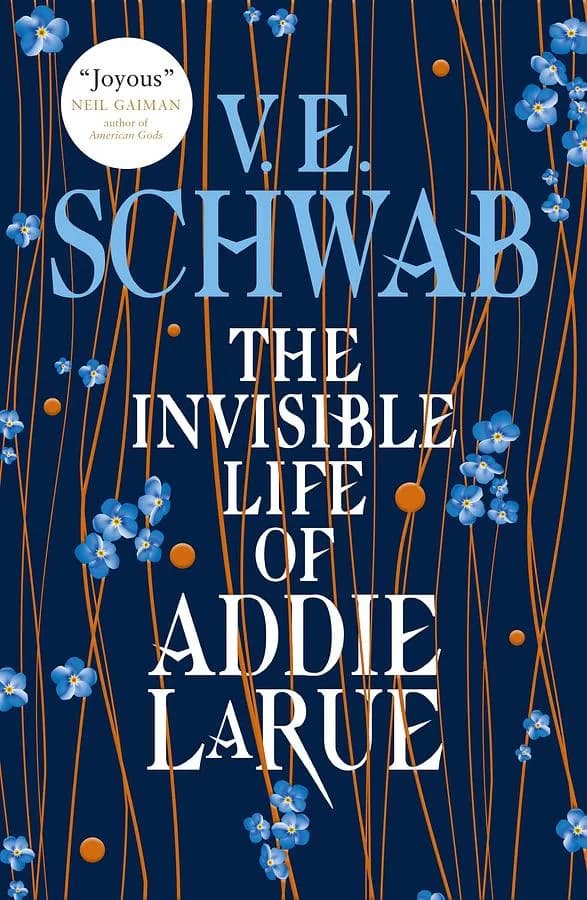
The Invisible Life of Addie LaRue
by V.E. Schwab
Book Club Date:November 2022
📖 Book Summary
You can name a hundred reasons for wanting immortality: not wanting to age, not wanting to lose anyone, not wanting to run out of time to confess your feelings. But can you answer: "If nobody remembers you, did you ever exist at all?" *The Invisible Life of Addie LaRue* (Traditional Chinese: 《艾笛的永生契約》) opens in 1714 France, where a young woman named Addie prays to the darkness to escape an arranged marriage and receives freedom and immortality — at a crueller cost: she will be forgotten by everyone. The moment she leaves someone's sight, every trace of her is deleted from the world's database. The story pivots in a modern New York second-hand bookshop, when someone says the impossible words to her: "I remember you." The novel alternates between a modern timeline and centuries-spanning flashbacks, turning "being forgotten" into a chronic, everyday, recurring loneliness.
✍️ Reading Notes
What Addie wants is actually quite simple: to belong to no one, to not have her fate arranged. That wish feels familiar in many women's lived experience, because "freedom" is often not an abstract ideal but the gasp of air that comes from stepping out of marriage, family, and social roles. Yet the freedom she trades the devil for is not the romantic "go wherever you please" version — it is more like an extreme disconnection: you can live a very long time, yet you can hardly leave any verifiable trace in the human world. That is when you discover that what truly destroys a person is not loneliness itself, but "having no echo." Everything you said, did, or loved has no one to bear witness, and eventually you yourself begin to wonder: if absolutely no one remembers me, am I still a whole person? The work's core explores the loss of "self." In Addie's deal with the demon Luc, she gains absolute freedom but loses the ability to leave any physical mark in reality — photographs, writing, signatures. I personally feel that Addie's curse is really "extreme solitude," and her rebellion is "becoming inspiration." Since she cannot create with her own hands, she becomes artists' muse, etching her soul into history through other people's artworks, texts, and paintings. Henry's appearance provides another entry point from modern society. Henry's deal is "to be accepted and liked by everyone" — the exact opposite of Addie's predicament, yet equally a curse. It looks strikingly like the social-media phenomenon of our time: we all crave living as a version of ourselves that others envy, viewing the world through filters. This addiction to "approval" is precisely what makes people lose touch with what is real. In our book-club discussion, this novel was compared with the film *Still Alice*. Alice is a Harvard professor who gradually loses memory and language to Alzheimer's. For Alice, "live in the moment" is a stance against disease; for Addie, it is three hundred years of survival instinct. Both are asking the same question: when memory is stripped away, what do we have left?
💬 Discussion Points
- 1Some people think "not being remembered" is lucky — it lets worries blow away; others believe "being forgotten" grants absolute privacy. Would you rather be the person who is forgotten, or the person who turns around and remembers nothing?
- 2Addie could not leave written words, yet she left traces by becoming artists' muse. In your life, beyond work and social-media posts, by what "title" or "means" do you most want to be remembered by the world?
- 3Henry craves universal approval, which causes him to lose his true self. In today's "views above all" society, how should we draw the line between "social-image masquerade" and "authentic self"? When "approval" becomes a survival necessity, does freedom still exist?