Mixed Signals
by Uri Gneezy
Book Club Date:December 2024
📖 Book Summary
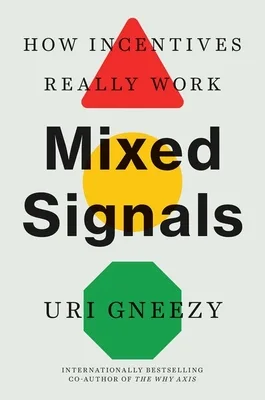
You can name a hundred reasons for "motivating others": give bonuses, offer promotions, set rules, impose fines. But can you explain why your carefully designed incentives so often backfire, sometimes making things even worse? *Mixed Signals: How Incentives Really Work* is written by behavioral economics master Uri Gneezy. He argues that the core reason incentives fail is that we send "Mixed Signals." When we try to guide the behavior of employees or children, the incentives we offer often convey a secondary message that contradicts our original intent. This book isn't merely a business management guide—it's a hands-on exercise in behavioral psychology and game theory. The book is structured like a "motivation laboratory": from the famous daycare-center late-pickup fine experiment to the psychology of compensation in charitable fundraising. It isn't just about economic profit; what it truly aims to do is: **redefine how we reach "behavioral consensus" with others by eliminating "mixed signals," and precisely use incentives to solve problems.**
✍️ Reading Notes
The book's most classic case is the "daycare late-pickup fine." When a school implemented a "three-dollar fine" to curb parents' tardiness, the number of late pickups actually doubled! This happened because the fine sent the wrong signal: previously, late parents felt uneasy (a negative social signal), but once a price was attached, their "moral obligation" transformed into a "paid service." Three dollars erased parental guilt, and the signal became "being late isn't so bad—just pay for it." This reminds us that a flawed reward system can convert intrinsic motivation into a cheap transaction. In workplace design, balancing "team incentives" and "individual incentives" is the key to success. If everything is individual rewards, employees become siloed and no one is willing to mentor newcomers. But if team incentives are cleverly designed, senior employees become more motivated to guide new hires hands-on and share their expertise. Under collective goals, veterans understand that "lifting up new blood" isn't just altruism—it's the best strategy for boosting overall capability and sharing in the rewards. Through this book, we learn that incentives are not merely financial transactions but a form of deep communication. Understanding users' mindsets and calibrating the weight of rewards and penalties is the only way to ensure the signals we send aren't distorted, steering teams toward long-term success.
💬 Discussion Points
- 1In your workplace or personal life, have you ever encountered a situation where "giving a reward actually made the other person perform worse"? Looking back, did that reward send the wrong "mixed signal" (e.g., turning someone's professional passion into a cheap transaction)?
- 2When the daycare's fine turned a "moral responsibility" into a "paid service," parental guilt disappeared. In your experience, is there something that you "originally felt embarrassed about, but felt perfectly justified doing once you paid for it"? What impact does this shift have on long-term interpersonal trust?
- 3When it comes to altruistic behavior (like collaborative book-club notes or community help), when do you think it's appropriate to rely on "goodwill (the warm-glow effect)" versus when to deploy the "silver bullet" of monetary incentives? Regarding those "small payments," do you feel they motivate you, or do they "crowd out" your enthusiasm?