
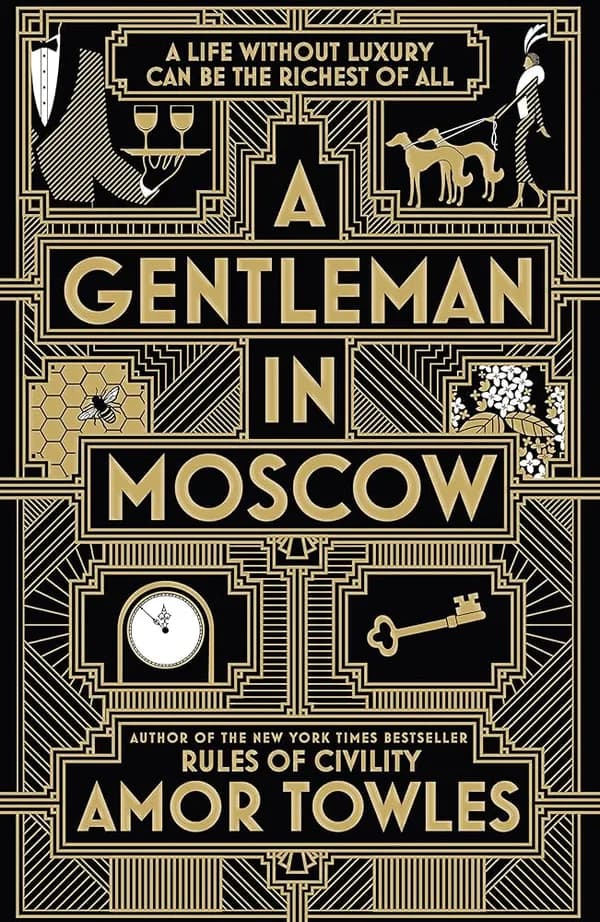
A Gentleman in Moscow
by Amor Towles
Book Club Date:December 2021
📖 Book Summary
If one day you were sentenced to "never leave this building for the rest of your life" — would you treat it as a prison, or find a way to live it as a city? *A Gentleman in Moscow* is Amor Towles' 2016 historical novel: in 1922, the new regime after the Russian Revolution hauls Count Alexander Rostov before a tribunal. As an aristocrat he would likely face execution, but a poem once read as "sympathetic to the revolution" saves his life, and he is sentenced instead to lifelong house arrest in Moscow's Hotel Metropol. He is moved from a grand suite to a cramped attic room; his life shrinks to a single address, yet history keeps running past the door. The hotel is no random stage. In reality the Metropol sits near Theatre Square in Moscow and was once one of the city's most lavish symbols — hot water, telephones, international cuisine, an American bar, even elevators — like a glass box locking modernity under one roof. Towles even compiled his own research notes on the Metropol, making the novel's paradox — "locked in, yet the world still spins in exquisite detail" — hold together. The novel spans over thirty years, compressing Soviet upheaval into the flow of human connections inside a single building. The Count meets actors, diplomats, officers, and all manner of staff — head chef, tailor, handyman, restaurant colleagues. Most importantly, he befriends Nina, a precocious nine-year-old girl, who years later entrusts him with her daughter Sofia, and a life forced into standstill unexpectedly grows a father-daughter bond.
✍️ Reading Notes
What makes this book so compelling is how it splits "freedom" into two versions: one is whether you can leave; the other is whether, when you cannot leave, you can still choose who you become. The Count is confined to the hotel — on the surface, the least free person imaginable — yet that very confinement shields him from the rougher tides of the era outside. He is like a specimen trapped under glass, yet that glass also preserves the rhythm of his breathing. His greatest act of defiance is not escape but turning daily life into a craft: arranging the tiny attic into his own "palace," using etiquette, taste, and routine to resist the stripping of identity and fate. Eventually he even sets aside his aristocratic posture and takes a job in the hotel restaurant, transforming from "the one being served" to "the one who serves." That pivot is key: he is not ingratiating himself with the new world; he is finding a posture he can stand in — when you cannot control the situation, at least you can control how you respond. One metaphor I particularly enjoyed: when he is forced out of his suite, he must choose the few belongings he can carry from a lifetime of collections and heirlooms. Humans are actually quite good at saying goodbye to people, but terrible at parting with things — because objects hold memories and safeguard a version of who we were. In the end he leaves behind most of his family treasures and takes only his sister's small pair of scissors. That decisiveness is actually painful: it is not that you have no attachment; it is that you have finally admitted "some things cannot come with you." Towles' humour is often tucked inside these "very seriously described everyday moments." Take the legendary bouillabaisse: it requires fifteen ingredients, several of which are chronically scarce and can only be assembled through luck, connections, and patience. On the surface it is a foodie scene; underneath it is saying the same thing — when the world is full of shortage and regulation, some people still choose to do one thing to perfection, like secretly lighting a lamp in the dark. Later you also notice the author keeps asking: what really makes a "nobleman"? Power, or responsibility? The Count's attachment to land, family, and city leads him to choices that look irrational: he could have fled far away, yet he returns to Moscow, as if walking into the muzzle of the era. But perhaps that is not blind loyalty — it is "I refuse to pretend I have nothing to do with this place." For some people, identity is not for showing off; it is for bearing weight.
💬 Discussion Points
- 1Which version of "freedom" resonates more with you: the right to leave, or the ability to choose how you live even when you cannot leave?
- 2The Count survives through etiquette, taste, and daily order. Do you see that as elegant resistance, or a form of self-anaesthesia?
- 3If you were forced to leave your familiar life carrying only a few belongings, what would you leave behind?