
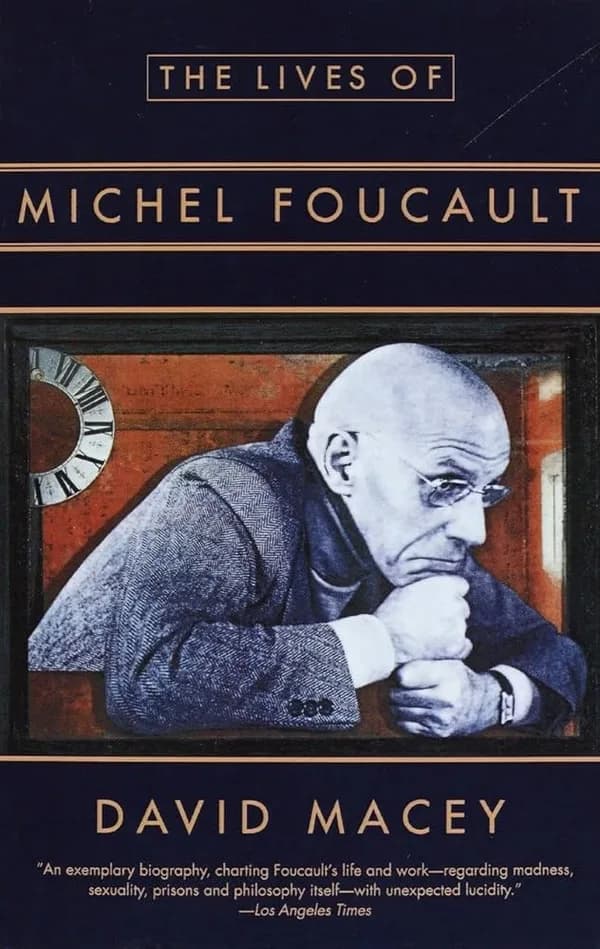
The Lives of Michel Foucault
by David Macey
Book Club Date:November 2024
📖 Book Summary
*The Lives of Michel Foucault* presents readers with a three-dimensional, multifaceted portrait of Foucault through extensive archival research and interviews. Written by David Macey, this biography delves deeply into Foucault's life and the impact of his thought on the social sciences, while also exploring his complex personal life, emotional relationships, and his positioning within the currents of his era. The book is not merely an academic biography but a captivating intellectual journey that allows readers to gain a comprehensive understanding of this profoundly influential philosopher. Moreover, the book examines Foucault not only from an academic perspective but from personal and social angles as well, presenting many little-known details through extensive documentation and interviews. Macey's writing style is accessible and approachable, making it especially suitable for readers without a French academic background. The new edition features a special essay by Foucault expert Stuart Elden, incorporating thirty years of new research to give the biography even greater authority. Foucault's remarkable life and lasting influence continue to fascinate, making this book an essential resource for understanding his thought and experiences. It is recommended for admirers of Foucault's philosophy, readers interested in philosophical biography, or anyone seeking to deepen their knowledge of 20th-century intellectual history—this book will guide you into Foucault's inner world and help you rediscover this great thinker.
✍️ Reading Notes
What I love most about reading Foucault through *The Lives* is that it immediately pulls you out of a dangerous illusion: we always assume life should grow into a single line, becoming clearer and more like a "finished product" as it lengthens. But Foucault's entire posture seems to say: stop kidding yourself—humans aren't finished products; they're ongoing rewriting projects, and what you consider your "true self" may simply be the configuration file set by a particular era, institution, or discourse. Foucault wrote in *The Order of Things*: "Man is an invention of recent date... and one perhaps nearing its end... like a face drawn in sand at the edge of the sea." This quote is often misread as pessimism, but through the lens of Macey's biography, it reads more like liberation: if "man" is merely a construction, then we have the possibility of reconstructing ourselves. This connects to Foucault's "technologies of the self": the relationship between a person and their self need not be an excavation of truth but rather a creative activity—a practice. Foucault as portrayed by Macey is fascinating precisely because he didn't just deconstruct concepts in his study. He traced a path from "how madness was defined" to "how medicine disciplined the body" to "how knowledge formed order" to "how power entered everyday life," and finally into the more intimate and more difficult territory: **how we craft ourselves within institutions.** The most ruthless aspect of this "crafting" is that it's not simply self-management—you simultaneously become your own object, tool, laboratory, and operator. You're being shaped while also shaping. This makes Foucault's body of work look less like an "unfinished collected works" and more like a series of turns and self-renovations: he kept changing topics not because he lacked focus, but because he was chasing a more stubborn kind of curiosity—the kind that makes you "lose your fondness for yourself." Reading this as depersonalization, desexualization, shifting the focus from "liberating desire" to "creating pleasure" feels very Foucauldian: he wanted to force you to swap out your moral script and change your life from "who should I become?" to "how might I live?" The biography's greatest value-add is that it doesn't treat Foucault's private life as gossip but as background pressure for understanding his thought. Macey writes about Foucault's long-term partner Daniel Defert's support for research and interviews, and the Verso edition explicitly states the biography was completed with Defert's full cooperation. When you place all of this back into Foucault's lifelong focus on power, the body, sexuality, and freedom, you understand more clearly: he was never talking only about theory—he was talking about "how to live." And this way of living was ultimately cut brutally short by the times: Foucault died on June 25, 1984, in Paris, regarded as one of the early significant public shadows of AIDS.
💬 Discussion Points
- 1Which statement do you agree with more: the goal of life is to "find your true self," or to "treat the self as a work of art you can create"? Why?
- 2If "man is an invention of recent date," what do you think today's most powerful "invention machine" is: education, the workplace, healthcare, social media, or intimate relationships?
- 3Foucauldian curiosity is the kind that makes a person "lose their fondness for themselves." Is there a question in your life that, once pursued, would force you to change your position? Would you be willing to follow it to the end?