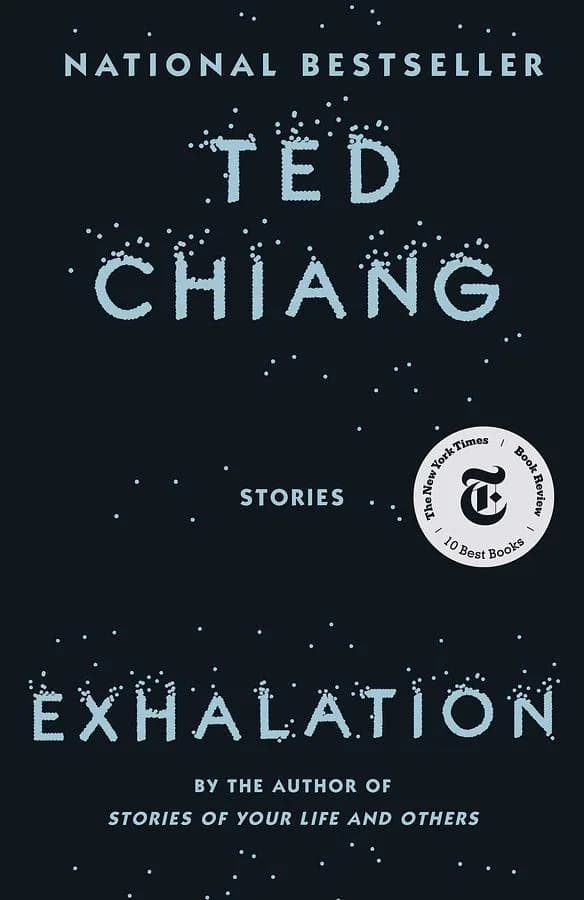
Exhalation
by Ted Chiang
Book Club Date:June 2023
📖 Book Summary
*Exhalation* is the long-awaited short-story collection from Ted Chiang, widely regarded as a "deity" in global science fiction. In three decades he has produced remarkably little, yet every story is legendary. His earlier *Stories of Your Life and Others* was adapted into the film *Arrival*, and *Exhalation* goes even further — earning a strong recommendation from Barack Obama as "the cream of science fiction." Drawing on physics, biology, and computational science, Chiang writes deeply felt dialogues about the soul, responsibility, and choice. The book's structure is like a "thought-experiment marathon": from an alchemical gate that lets you return to the past but never change the outcome, to a communication device that connects you with a parallel universe, to the rights and evolution of artificial intelligence. What Chiang truly wants to do is redefine the meaning of "hope" and "character" within the cold constraints of physical law.
✍️ Reading Notes
I have always felt that Chiang's craftiest move is that he rarely uses "the apocalypse" to make you nervous. More often he takes a seemingly cool technology and backs you into a far more primal question: if you already knew the outcome (or saw an alternative outcome), how would you still choose to live? Take "Anxiety Is the Dizziness of Freedom." It makes "free-will anxiety" viscerally concrete: people can use a "paralogon" to talk to versions of themselves in parallel universes who made different decisions at the same crossroads. Sounds amazing — until it starts corroding your ability to choose. You stop asking "what do I want?" and start asking "which me is more successful?" Life becomes a never-finished comparison chart, and people even need "paralogon-recovery" support groups to re-learn how to make a decision — not to beat another version of yourself, but to make the present you whole. The line is spot-on: every decision is part of your character, shaping who you become. But Chiang does not only write about freedom being dizzying. He also writes a colder horror: what if determinism is real? "The Merchant and the Alchemist's Gate" uses time travel to deliver an almost cruel consolation: you can go back, you can see, but you cannot change a thing. The story's real task is not "how to rewrite your life" but "how to make peace with it." Because once you understand that nothing can be changed, you are forced to learn something harder: turning regret into understanding, and understanding into a way to keep living. Then there is "The Lifecycle of Software Objects," which writes "AI ethics" as a slow burn: when a virtual creature already feels like a pet, like a child, like a partner, can you still treat it as a tool? When it can learn, attach, and be hurt, who bears responsibility? When AI is not smart enough, we talk only about risk; when AI becomes too lifelike, we have no choice but to discuss rights, obligations, even "does it count as someone." Chiang's brilliance is that he does not rush to legislate — he first makes you emotionally admit: you have already started treating it as some kind of life. So although the author himself may not want to be called a fabulist, every story in *Exhalation* leaves the same aftershock: you are not lectured — you are forced into greater honesty. You begin to accept a contradictory but practical conclusion: perhaps the world truly has its structures and limits, but within those limits a person still needs to make a choice about themselves — not to pick the most perfect ending, but to pick the version of yourself you are willing to shoulder and willing to become.
💬 Discussion Points
- 1If a "paralogon" really existed and you could talk to a version of yourself from another timeline who made a different decision, would that give you more courage to face your current life, or trap you in endless comparison and regret?
- 2Between determinism (outcomes cannot be changed) and free will (the future can be created), which worldview gives you a greater sense of security? If you knew the future was already set, would you maintain your current level of effort?
- 3When AI (like the virtual creatures in the book) develops emotion and consciousness indistinguishable from a human's, should we regard it as "an individual with rights" or "a powerful piece of property"? If it makes a mistake, should responsibility fall on the developer, the owner, or the AI itself?