
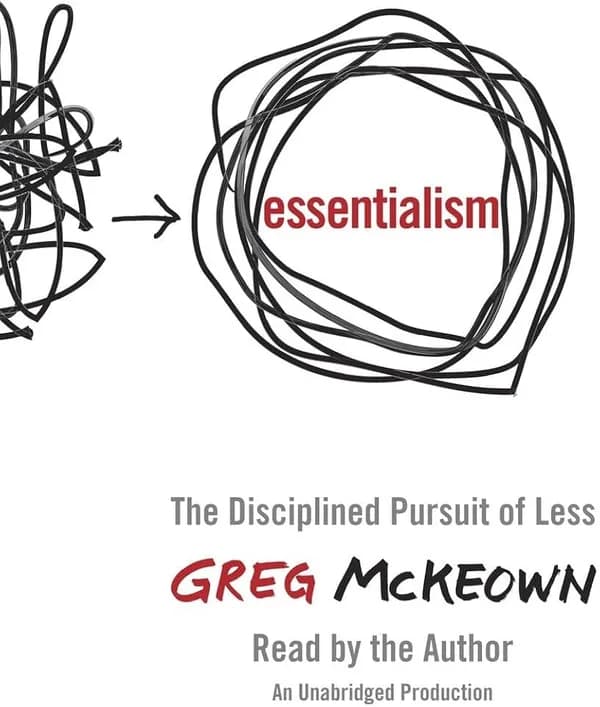
Essentialism: The Disciplined Pursuit of Less
by Greg McKeown
Book Club Date:October 2022
📖 Book Summary
*Essentialism: The Disciplined Pursuit of Less* takes the state of being "crazy busy" apart and tells us: you are not lacking effort — you are spreading your energy across too many things that are not actually that important. Author Greg McKeown proposes "Essentialism": not doing everything, but identifying the vital few and getting better results with less input. The method is often condensed into three steps: first **Explore** (discern), then **Eliminate** (simplify), and finally **Execute** (with precision) — using discipline to reclaim your life from the noise.
✍️ Reading Notes
This book turns "I'm so busy" from a badge of honour into a distress signal: when you say yes to everything and try to juggle it all, you are essentially outsourcing control of your life to other people's expectations and calendars. Essentialism looks like time management on the surface, but at its core it is about value-ranking: are you willing to admit that some tasks, no matter how well executed, are just "looking busy" and will never take you where you want to go? This also explains why we clearly hate being chased by trivia yet keep getting kidnapped by the sunk-cost fallacy — like insisting on attending an event because we already bought the ticket, or clinging to a project because we have already invested so much. The result is not getting closer to the goal, but closer to a breakdown. The sunk-cost trap works precisely because the more you have invested, the harder it is to admit "I should have stopped." The book also highlights a very real paradox: success brings more options, and more options scatter your attention until you start using "busy" to prove your importance while dragging the truly important stuff to tomorrow. At that point, essentialism is not asking you to become cold-hearted; it is asking you to deploy your goodness at the decisive point: use refusal to protect focus, simplification to protect energy, and designed routines to protect execution. You may even discover that many "perfectly reasonable" decisions are all secretly asking the same question: what exactly did I put in first place? The book cites the 1982 Tylenol cyanide-poisoning incident as one example: a company faced the trade-off between PR and human life, ultimately triggering a massive recall and changes to product-safety standards. Such crises become classics precisely because they force organisations to lay their value hierarchy out in the open. The sentence I most want to keep from this book: "Less is not laziness; less is turning life's volume knob back into your own hands. And 'better' is not more perfect — it is more aligned with the direction you truly want."
💬 Discussion Points
- 1What was the most recent thing you agreed to even though you clearly did not want to?
- 2Is there a classic "sunk-cost pit" in your life — something you have invested too much in to stop, even though you are drifting further off course?
- 3If you could choose just one thing to make this year "less, but better," what would you cut, what would you keep, and how would you make it easier to execute?