
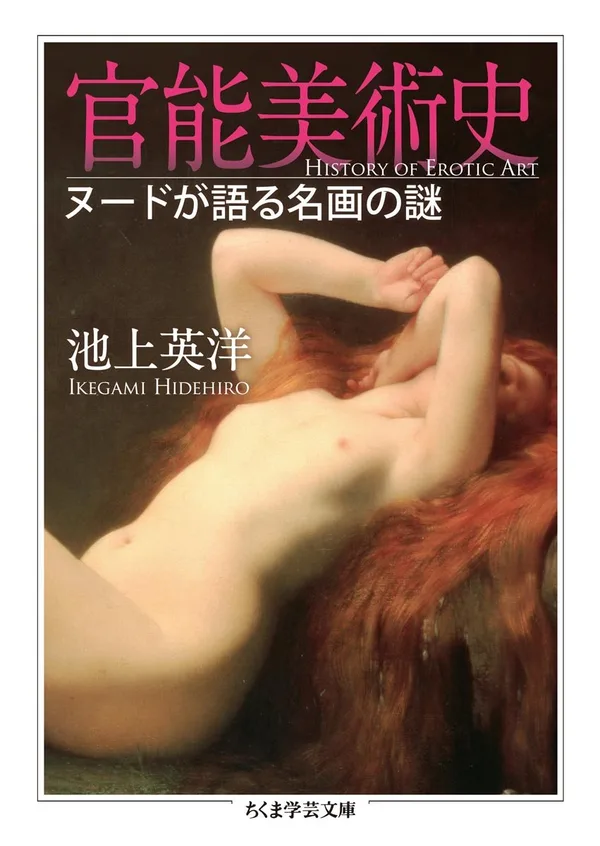
History of Erotic Art
by Ikegami Hidehiro
Book Club Date:March 2023
📖 Book Summary
You can name a hundred reasons why "art should be lofty and pure" — to refine temperament, to manifest the divine, to pursue proportion, to hang in the Louvre. But can you explain "why sex and beauty are inseparable"? *An Erotic History of Art* is a dissection of human desire, love–hate, and social taboo through Western art history. Since the dawn of civilisation, "love" and "death" have been humanity's two great obsessions. Painters never shied away from these subjects — and often hid daring allusions behind masterpieces. Rembrandt, beyond *The Night Watch*, painted countless works alluding to intercourse; Da Vinci recorded the physiology of sex in his anatomical drawings; and the Realist master Courbet broke new ground on canvas with erotic and lesbian subjects. The book is structured like a guided tour from altar to bedchamber: from ancient Greece's open worship of the body, through the "desire-yet-dare-not-speak" repression of the medieval Church, to how modern artists mounted tiny rebellions under Inquisition and censorship. Author Ikegami Hidehiro uses a wealth of images (analysing around 200 famous paintings) to track how nudity, desire, symbols, mythology, and biblical themes were painted onto canvas — and explains how "taboo" in turn stimulated creation, with equal parts gossip and rigour.
✍️ Reading Notes
The most captivating thing about this book is how it restores the goddess Aphrodite to her "true colours." In Chinese we elegantly call her "the goddess of love, Venus," but etymologically she was born from the foam of the severed genitals of Ouranos cast into the sea. The Greeks' attitude toward sex was supremely natural; Aphrodite governed not just spiritual love but raw carnal desire. Her endless affairs and bold-as-brass personality reflected ancient Greek civilisation's frankness about the "appetite for life." By contrast, after the Middle Ages, under Christian repression, Western expression of sexuality became veiled and anxious — a shift that profoundly shaped a millennium of artistic style. Yet where exactly is the line between "art" and "pornography"? This double standard has tormented generations of artists. It reminds me of how, as school kids, we may have drawn crude nude stick figures on the back of our textbooks (earning a warning), yet the equally nude Venus de Milo is worshipped in the Louvre. Goya had to paint both a "clothed" and a "nude" version of La Maja to dodge the Inquisition; Taiwanese sculptor Huang Tu-shui's *Sweet Dew* was once deemed "obscene" during the militarist Shōwa era. The point is: what counts as "beauty" often depends on the prevailing political and religious winds. Even more interesting is the observation of the "male gaze." Walk into a museum and you will find that over sixty per cent of the works are human figures, and of those, roughly ninety per cent are female nudes. Women's groups have posed the pointed question: "Do women have to be naked to get into the Metropolitan Museum?" For centuries, male painters actively gazed and defined beauty while women were subjects to be tested and judged. Although contemporary artists such as Jenny Saville fight back by painting unconventional, fleshy female bodies, breaking a thousand-year tradition of "nude-woman aesthetics" remains an uphill battle. Finally, the "[nude-tile at home](https://www.instagram.com/p/CrgLggEvBM_/?utm_source=ig_web_copy_link&igsh=MzRlODBiNWFlZA==)" we mentioned on our IG fits perfectly as supplementary reading, because it reminds us that erotic imagery has never been confined to galleries — it lives in everyday corners, often used to "set the mood," catalyse desire, or simply serve as an unspoken joke. Archaeological finds in Pompeii show that erotic images appeared not only in brothels but in private homes and public spaces. So after reading *An Erotic History of Art*, you probably will not find a perfect dividing line, but you will gain a more mature question: are we really discussing the art of the human body, or are we discussing how society permits us to look at desire?
💬 Discussion Points
- 1Do you think the line between "art" and "pornography" is more about content explicitness, or about viewing context (setting, power, consent)?
- 2Once it is pointed out that museums contain "many female nudes but few female artists," would you prefer to change the collection system, or change the way we look?
- 3If you could annotate one classic nude with a "modern ethical footnote," what line would you add? (e.g. Who is looking? Who is looked at? Who decides? Who is omitted?)