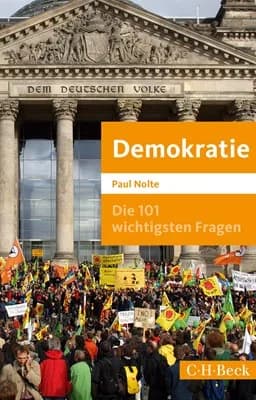
Die 101 wichtigsten Fragen: Demokratie
by Paul Nolte
Book Club Date:August 2021
📖 Book Summary
The pandemic years have been like a floodlight, exposing political questions that were always hiding in plain sight: How far can government reach? Should freedom give way to safety? How transparent does information have to be before it counts as "democratic"? And the sceptical voices have grown louder: is democracy over-romanticised? Is it really better? Or have we simply gotten used to its language? *Die 101 wichtigsten Fragen: Demokratie* reads like a checklist of democracy's essential equipment. Author Paul Nolte uses 101 questions to disassemble democracy: from "what is democracy, really" — a question that sounds simple but is the easiest to turn into a slogan — all the way to elections, media, the internet, minority rights, institutional efficiency, and future crises. The tone is not that of a lofty textbook but of a friend who keeps pressing you, forcing you to explain each concept clearly: you are welcome to be dissatisfied with democracy, but first you need to know which version of democracy, which part of the system, and which kind of failure you are dissatisfied with. The book also works well as a reading-group tool: each question acts like a small switch that, once flipped, connects to history, rights, and social structure, and ultimately forces you back into your own life experience to make a judgment. It does not aim to make you love democracy more — it aims to make you think about democracy better.
✍️ Reading Notes
What I appreciate most about this book is its opening posture: it admits democracy is not an angel. Historically, the word "democracy" carried a bad reputation for a long time — mob violence, incompetence, noise, short-sightedness — as if it were only hauled out during unavoidable turmoil. Yet after institutional evolution, social expansion, and the gradual formation of rights concepts, people simultaneously conceded something they were even more reluctant to admit: democracy is a hassle, but it is also very hard to replace. That ambivalence is exactly what we feel in daily life today. And when democracy is crushed, what shadow does it leave? On the topic of Tiananmen, even mainstream international reporting acknowledges that the Chinese government has never released an official death toll; outside estimates vary enormously, but "possibly reaching thousands" is a common figure, and declassified diplomatic documents have put estimates as high as "close to ten thousand." In Hong Kong, the Victoria Park candlelight vigil was once one of the few large-scale public ceremonies in the world where June Fourth could be openly commemorated, but since 2020 it has been repeatedly banned — nominally for pandemic reasons — followed by tightening political and legal pressure, turning "whether you can legally mourn" into a thermometer of freedom itself. Placing these two threads side by side, the book is really forcing you to see the same core point: democracy is not a beautiful slogan but a piece of institutional engineering that needs to be maintained, patched, and updated. It may produce runaway bureaucracy or widespread public disappointment, but it preserves at least one critical mechanism: you can question, you can demand, you can participate, and you can even pull the system back. Halfway through, two images of "democratic failure" kept surfacing in my mind. They look very different, but they are talking about the same thing: the distance between people and decisions. One classic satire of the "democratic deficit" is the EU's old produce-specification standards, which once regulated cucumber curvature down to "a maximum bend of 10 mm per 10 cm of length." It became a symbol of bureaucratic over-reach and was indeed relaxed or repealed around 2009, with the European Commission cheerfully talking about "letting crooked cucumbers back on the market." The point is not whether cucumbers should be straight. The point is: when decisions feel too far from everyday life and too hard for ordinary people to influence, people start feeling like managed subjects rather than owners of the system. That is the democratic-deficit fatigue of "participation running a deficit." So what can address this problem? Audrey Tang's "open government" model offers a promising example: with 5,000 signatures a topic enters a monthly meeting for voting, and selected issues proceed to collaborative conferences. Even the notoriously clunky Taiwanese tax-filing software was gradually refined through collaboration between civic tech volunteers and government — resulting in the much more usable system of today. It is not a perfect solution, but it is at least trying to shorten the distance between people and decisions — the stretch that erodes trust the most. So for me, *Die 101 wichtigsten Fragen: Demokratie* is ultimately a reminder: we can be disappointed in democracy, but we should not leap from "disappointed" straight to "give up." Democracy's value may not be that it always gets things right, but that it lets you take the mistakes out and fix them.
💬 Discussion Points
- 1When have you been most disappointed in democracy: too slow, too noisy, too chaotic with information, or "I cannot influence anything at all"? Do you think that is a problem with democracy itself, or with the design and implementation of the system?
- 2Do you feel the "democratic deficit" in your own life? Have you ever encountered a situation where "the rules are thorough, the process looks great, but I just cannot participate"?
- 3When safety and freedom collide (as in a pandemic, war, or national-security crisis), how should a democratic society decide "how much to give up"? What mechanism can prevent a one-way slide into irreversible control?