
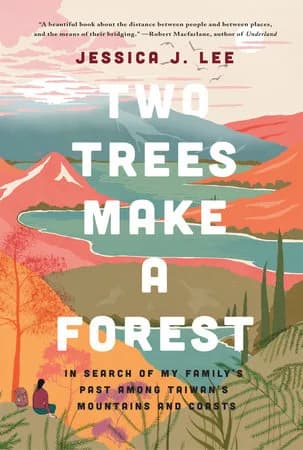
Two Trees Make a Forest
by Jessica J. Lee
Book Club Date:March 2025
📖 Book Summary
*Two Trees Make a Forest* is written by Jessica J. Lee, a Canadian-Taiwanese environmental historian. The story begins with a letter found among her grandmother's belongings, handwritten by her grandfather in Chinese. For Lee, whose Chinese ability is limited, this letter was like a "family instruction manual" whose password had been lost. To crack this mystery spanning borders and languages, she traveled from Canada back to her mother's homeland—Taiwan—attempting to piece together the historical fragments hidden behind her family's silence among earthquake fault lines, subtropical rainforests, and towering mountain ranges. The book's structure reads like a "dual archaeology of geology and genetics": she weaves together plant taxonomy, terrain evolution, cross-strait migration, and identity formation. If you treat it as a simple travel book, you'll miss its depth—it redefines what you might consider a "ruptured" personal identity as a profound dialogue with land, language, and memory.
✍️ Reading Notes
The book's most delicate observation is the "gray zone of translation." When the author tries to decipher her grandfather's letter, she discovers that language isn't merely symbols but layers upon layers of thick "cultural filters." The indirectness of Chinese (such as using "have you eaten?" in place of "I love you") means the original emotions are often diluted or misread when converted to English. This leads the author to realize that when her mother served as "translator," she was also invisibly "interpreting" and even "rewriting" family memory. This raises a fascinating question: if we lose the language of our ancestors, can we still fully inherit our family's story? As an environmental historian, the author provides a powerful answer: language is a bridge, but the land is the ultimate witness. She ventures deep into Taiwan's mountains and forests, discovering that changes in place names (such as Bangka becoming Wanhua, Damaau becoming Minxiong, Qilian becoming Linong) are essentially the correction fluid of power and culture. Place names aren't just markers—they're the land's "tattoos." Even as regime changes attempt to erase past traces, suppressed cultural imprints (like the lingering echoes of Pingpu indigenous languages) still lie quietly within topographic details. Just as "Neili" transformed from "Nei-jian-zi-lek" to "Kham-a-kha," place names encapsulate the trajectories of ancestral movement and settlement. After reading this book, you'll discover that "self-identity" doesn't necessarily need to be built on perfect mother-tongue proficiency. Family memory sometimes resides in non-textual vessels: in the sighs your grandfather left unwritten in his letter, in the familiar dish your mother cooks, or in the island landscape beneath your feet—battered by earthquakes and typhoons yet still resilient.
💬 Discussion Points
- 1When your family's history "manual" is written in a language you can't fully understand (like the Chinese letter in the book), do you think this creates a sense of "disconnection" from your family, or does it motivate you to seek your roots through "non-linguistic means" (like visiting ancestral homes or tasting old recipes)?
- 2Taiwan's place-name changes reveal how regimes redefine the memory of land. In your hometown or the place where you grew up, are there any vanished place names you feel must be recovered? When a place's name is changed, does the "soul" of that place change along with it?
- 3The author discovers that family memory exists not only in text but also in "habits and behaviors." Looking back at your own family, what behaviors or habits have your elders silently passed down to you without ever saying a word—an "invisible family inheritance"? Does this give you a more honest awareness of your multiple identities?