
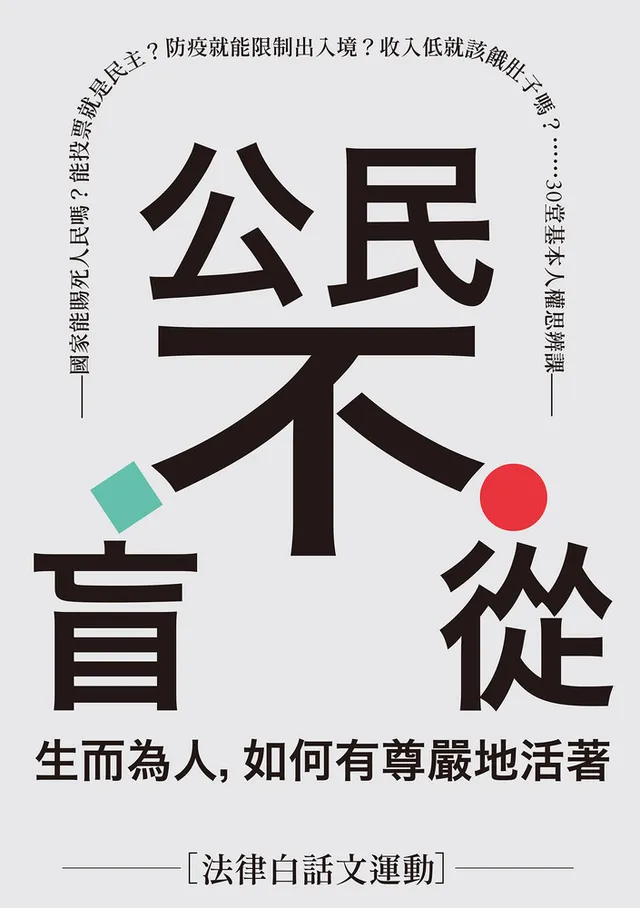
Citizens Don't Follow Blindly
by Plain Law Movement
Book Club Date:August 2023
📖 Book Summary
*Citizens Who Don't Follow Blindly: Born Human, How to Live with Dignity — Can a State Execute Its People? Does Having Elections Mean Democracy? Can Pandemic Control Restrict Border Crossings? Should Low Income Mean Going Hungry? … 30 Lessons in Fundamental Human-Rights Thinking* is an "owner's manual" for the civilised world. Using the United Nations' simplified thirty-article version of the *Universal Declaration of Human Rights* as its skeleton, it explains — article by article — what each provision truly seeks to protect, and uses extensive domestic and international cases to translate cold legal text into realities you and I encounter every day.
✍️ Reading Notes
What I think is smartest about this book is that it does not treat human rights as a "moral sticker" but as a "thinking toolkit for when controversy hits, so you don't get swept up by the crowd." Because in real life, the most common way human rights die is not by being publicly ripped up but by being gently covered over with a familiar line: for public safety, for good morals, for national security, for your own good, for the bigger picture. So you think you are supporting order, when you may actually be helping someone lock rights in a closet. Using the "war on drugs" as an example fits this book's approach well: take a massive policy everyone has heard of but rarely truly unpacks, and disassemble it into a human-rights jigsaw puzzle. When the UN Office of the High Commissioner for Human Rights (OHCHR) issued its statement on 23 June 2023, it was blunt: the international community should replace punishment with "support and encouragement," centring the respect, protection, and fulfilment of everyone's rights, and calling for an end to the global "war on drugs" paradigm. Why? Because relying solely on penalties and force rarely eliminates demand and supply, yet easily crushes the vulnerable first: easier to arrest, label, incarcerate, and exclude from education and employment, ultimately creating a vicious cycle of "harder to survive, so more dependent on highs." That is when you realise human rights are not gentle platitudes; they are a policy floor: you can fight drugs, but you cannot use that fight to justify disproportionate humiliation, discrimination, torture, or arbitrary detention. Digging deeper, the book's core backdrop is the historical bind of the UDHR and the two Covenants. The Declaration was adopted on 10 December 1948, like writing a bottom line for humanity: "even if you are a state, you may not treat people as expendable." But turning that bottom line into enforceable institutions later led to the more binding covenant framework — the ICCPR and ICESCR, which entered into force in 1976. The point: writing it down does not equal doing it. The clearer the provisions, the more they collide with each country's existing laws, political realities, and ideological conflicts. So "human rights" often becomes something everyone agrees on in principle yet argues about the moment implementation begins. The observation that "sex work in Taiwan is not truly illegal" also fits this book's flavour: the same issue can carry moral emotion, but whether policy should follow suit is a different level. Judicial Interpretation No. 666 ruled that "punishing the seller but not the buyer" violates the principle of equality, subsequently prompting amendments to the Social Order Maintenance Act, including a design allowing local governments to designate sex-work zones. Yet even though the system grants localities the power to decide, most localities dare not act, so the result may be "nominally regulated, practically further underground," spawning harder-to-govern violence, exploitation, and health risks. Reading *Citizens Who Don't Follow Blindly* at this point hits hard: human rights do not ask you to pick a side instantly; they ask you to separate "stigma" from "governance" and "I dislike it" from "how should the law protect people." This book does not try to turn you into a perfect citizen. It tries to give you one extra habit the next time you see a hot controversy: first ask, "Whose rights does this sacrifice? Is that sacrifice necessary? Is there a less harmful way?" Once you start asking those questions, you become a lot harder to lead blindly.
💬 Discussion Points
- 1What do you think is the most overlooked human-rights cost of the "war on drugs": arbitrary detention, stigma and discrimination, inadequate medical resources, or violent enforcement? If the approach shifted to "support over punishment," which policy would you change first?
- 2After Judicial Interpretation No. 666, Taiwan left a framework for local governments to plan "sex-work zones," yet most localities have refused to act for years. Do you consider that democracy or buck-passing? From a human-rights perspective, whose rights should be protected first?
- 3Which "human-rights gap" do you encounter most often in daily life: speech and assembly, privacy, work and housing, or health and education? What reason do you think Taiwan most readily uses to "temporarily shelve" it?