
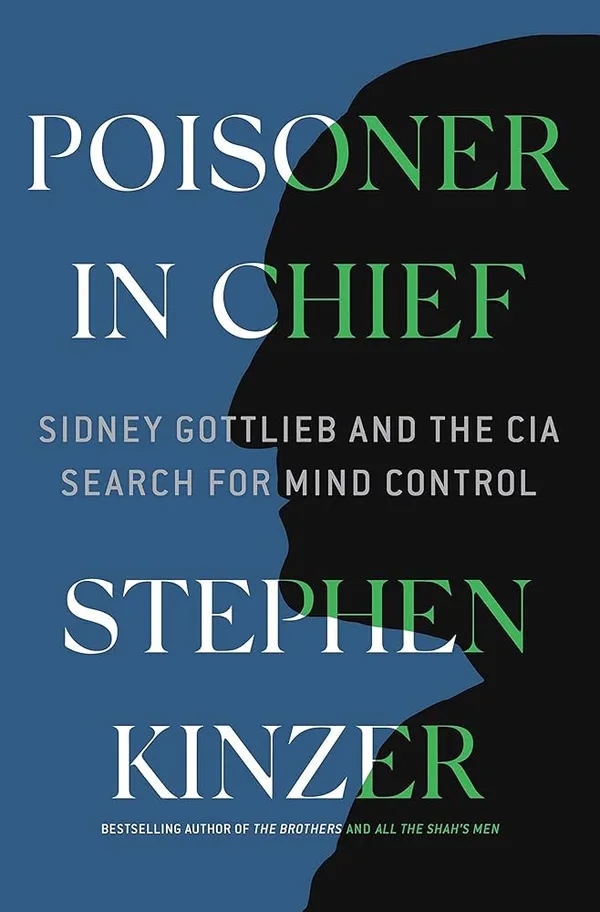
Poisoner in Chief
by Stephen Kinzer
Book Club Date:November 2021
📖 Book Summary
If someone tells you "we are at war," you instinctively feel that a lot of things can be given "special treatment." *Poisoner in Chief* is about how that "special treatment" kept sliding downhill: in the early Cold War, the United States feared the Soviet Union or China had cracked the secret of "mind control," so the CIA treated it as a technological arms race that had to be matched, launching years of mind-control research. Author Stephen Kinzer puts the spotlight on an unremarkable-looking chemist who wielded enormous power: Sidney Gottlieb. He directed MK-ULTRA and related programmes — from drugs to interrogation to all manner of "technical support" — attempting to find methods that could make people confess, lose control, or even be "rewritten." The book reads as part historical account, part dark fable: when a state escalates fear into a mission, the individual's body and will can be downgraded to raw material.
✍️ Reading Notes
The most spine-chilling part of this book is not the moral conclusion "the CIA is evil." It is the mechanism it forces you to see: everything can be packaged as "necessary." In that era, mind control was a legendary weapon; everyone believed that if only they could find that key, they could unlock enemy mouths and shut down enemy wills. So research was accelerated, limits were loosened, and language was bleached: torture became "enhanced measures," drugging became "technical testing," and people became "subjects." You read along and feel the absurdity: some conclusions were practically common sense, yet they had to be confirmed through massive human experimentation before anyone would acknowledge them. Even more absurd, when certain drugs proved "unreliable," the next step was not to stop but to try something more extreme and less controllable. That is when I understood the book's true horror: it is not about a genius madman — it is about how an organisation, caught in the collective anxiety of "we cannot fall behind," treated loss of control as progress and harm as cost. What pulls the story back to the human level are the moments when "innocent everyday life" gets dragged in by force. Someone just walked into a café, someone just attended a gathering, someone was inside the system and suddenly had a crisis of conscience — and their life veered off course. The shadow of Gottlieb and MK-ULTRA lingers partly because many files were ordered destroyed in 1973; the truth that could later be pieced together was always full of gaps. That feeling of "you can never know the full picture" is itself another form of control: not controlling your brain, but controlling how much you are allowed to understand. The most ironic scene is when the CIA brought in top-tier magicians to write secret manuals teaching how to "complete an action without being noticed." On stage, deception is performance; transported into the intelligence world, it becomes the vanishing act of operational ethics. You start asking: when a system treats "deception" as a professional skill and "unspeakable" as the norm, whose safety is "national security" really protecting? Toward the end, another timeline kept surfacing in my mind: in 2009, Obama signed an executive order requiring interrogations to comply with the law and restricting torture methods — like taping a bandage over the black box of a previous generation. But a bandage does not make you forget there was bleeding. The book's greatest achievement is not turning history into sensationalism; it is forcing you to admit: what is truly terrifying is not a particular conspiracy, but that "when fear is big enough," many people will genuinely believe they are doing the right thing.
💬 Discussion Points
- 1If a single phrase — "for national security" — can widen the boundaries, where do you think the line should be drawn?
- 2The most common thing in this book is not "evil" but "rationalisation." In your own life or work, what forms of rationalisation have you seen quietly eroding the bottom line?
- 3When truth has been destroyed, concealed, and reduced to fragments, how can we still conduct public oversight? Do you believe "transparency" can keep up with the speed of power?