
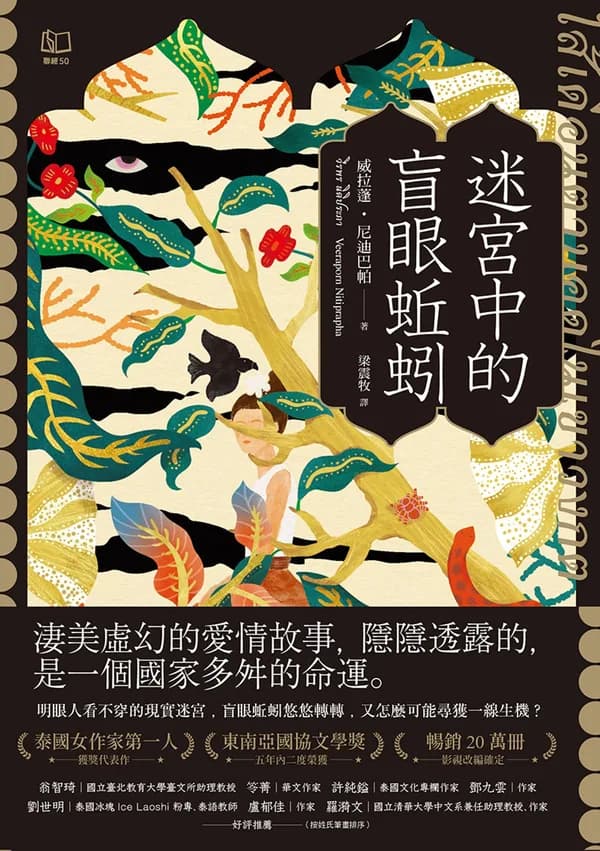
Blind Worms in the Labyrinth
by Veeraporn Nitiprabha
Book Club Date:July 2024
📖 Book Summary
You can name a hundred reasons why "Thai soap operas are absurdly dramatic": scumbag men everywhere, tragic love-suicide plotlines, all manner of outlandish coincidences and fantastical elements. But can you articulate the political truths hidden behind these seemingly ludicrous storylines—truths that must be told "the long way around" because direct speech is restricted? *The Blind Earthworm in the Labyrinth* is an award-winning masterpiece by Veeraporn Nitiprapha, a major contemporary Thai author. Through elegant, lyrical, and even aestheticized prose, she paints fated moments that feel like folk songs and myths. On the surface, the story is a high-tension romantic entanglement, but it precisely maps onto the real upheavals of Thai society. Veeraporn uses magical realist techniques to transform nearly a century of Thailand's spiritual turbulence into a "paper labyrinth," leading readers step by step—through the illusion of romance—into the depths of historical and political dislocation.
✍️ Reading Notes
The most thought-provoking question this book raises is: why can't the author write about politics directly, resorting instead to the detour of romance? In Thailand, due to the *lèse-majesté* law and frequent military coups, the space for free expression is tightly monitored. When political reality is as constricting as a labyrinth, literature becomes the "blind earthworm," groping for a way out in the dark. This repression has given rise to remarkably creative protest culture: protesters transform pop-culture symbols into weapons, such as rewriting the *Hamtaro* theme song into lyrics satirizing corruption, or raising the "three-finger salute" from *The Hunger Games*. This "cinematic protest" isn't just about attracting media attention—it's about using implication to circumvent risk under harsh laws. The book's backdrop is closely tied to the 2010 "Red Shirt–Yellow Shirt" conflict. The Yellow Shirts represented the urban middle class and conservative forces; the Red Shirts represented rural communities seeking democratic reform. This deep societal rift, along with the rise of the younger generation in 2020, is transformed in Veeraporn's prose into a kind of "process of disorder." Through the image of the "blind earthworm," the author metaphorizes the helplessness of Thai people caught in the tangles of history and politics—even as diligent as earthworms tilling the soil, they can never see the exit, wandering endlessly between collective memory and collective forgetting. Additionally, the book's lavish descriptions of the Thai landscape and the metaphor of "Nang Nak" (the ghost of Nana) showcase Thai culture's unique blend of self-deprecation and resignation. The influx of foreign tourists and the displacement of local culture give this island nation a captivating yet melancholic mirage. The love in Veeraporn's writing isn't chicken soup—it's a slow "collective love-suicide," symbolizing the collapse of ideals under the crushing weight of reality. After reading this book, you'll realize those exaggerated plot twists aren't meant for entertainment—they're meant to carry pain that cannot be spoken aloud. As the book conveys, Thailand is a beautiful labyrinth, and everyone inside it is trying to break free from those pre-determined "fated moments" to carve out a sliver of freedom that is truly their own.
💬 Discussion Points
- 1In societies where free speech is restricted (like the Thailand depicted in this book), people are forced to wrap political critique in romance or pop culture (like Hamtaro or Voldemort). Do you think this kind of "oblique protest" enhances the vitality of the message's spread, or does it actually blur the political focus that should be confronted head-on?
- 2The "blind earthworm" lives in the labyrinth, symbolizing the compulsion to keep moving forward even when you can't see the exit. Reflecting on your own life or work environment, have you ever felt like this earthworm? In that state of "powerlessness to change the system," would you choose to lose yourself in the illusion of love like the characters in the book, or would you seek other exits?
- 3The book mentions that Thai people address politicians with familial terms (uncle, auntie), which to some extent dilutes the seriousness of holding power accountable. Do you think this "familial" political rhetoric serves as a gentle buffer for a nation's democratization process, or is it a form of invisible control?