
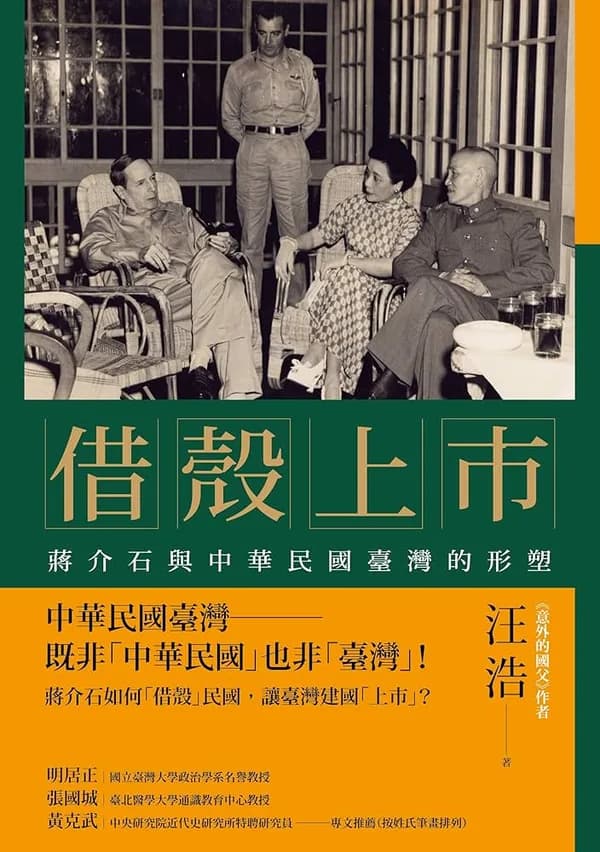
Backdoor Listing
by Wang Hao
Book Club Date:March 2022
📖 Book Summary
Wang Hao borrows the concept of a "reverse merger" (or "backdoor listing"): a private company injects its assets into an already-listed shell company with a low market cap, using that shell to gain listed status in one move. What he wants to say is: after the Nationalist government retreated to Taiwan in 1949, the "Republic of China" gradually became little more than a shell on the international stage. But after the Korean War broke out in 1950 and the Cold War framework took shape, Taiwan's geostrategic value, governing reality, and international positioning were all poured into that shell, forming what he calls the political reality of "Republic of China on Taiwan." This is also why Tsai Ing-wen's 2020 inaugural address used the phrase "over the past seventy years, 'the Republic of China (Taiwan)' …" to mark a redefined historical starting point. More interestingly, the author does not just argue from "viewpoints" — he backs it up with evidence: extensive use of declassified historical materials and Chiang Kai-shek's diaries, among other sources, trying to pull readers back from hindsight to see how the decision-makers judged, rationalised, and navigated between ideals and reality in real time.
✍️ Reading Notes
If, like me, your student-era Taiwanese history often read like "an appendix to modern Chinese history," then the first thing *Reverse Merger* does is wrench the camera back: Taiwan is not the appendix — Taiwan is the main storyline; and the pivotal turning point, the author insists, is 1950. Why 1950? Because that year the Korean War broke out, and US President Truman publicly declared that the Seventh Fleet would prevent any attack across the Taiwan Strait, placing the Taiwan question inside the framework of "Cold War security." Once that security narrative was established, Taiwan was no longer just "a piece of territory awaiting postwar disposal" — it was locked into a critical node in great-power strategy. You could call it protection, or you could call it the beginning of letting others put a price on your fate. Next, the book walks you through two treaties with similar names but very different implications. The 1951 San Francisco Peace Treaty explicitly states that Japan renounces "all right, title and claim to Formosa and the Pescadores" — but it does not say "renounces to whom." That blank would become the starting point for decades of competing narratives: some argue it leaves sovereignty in a legal grey zone; others counter that real-world governance and recognition are what matter, and legal wording should not be endlessly inflated. The following year, the 1952 Treaty of Taipei (also known as the Sino-Japanese Peace Treaty) again addresses Japan's renunciation of Taiwan and the Pescadores, but is similarly claimed by different camps to support different conclusions: some view it as a piece of the international-law puzzle; others see it more as a "political patch," fixing the diplomatic situation of the moment rather than stamping Taiwan's identity. At this point, the "backdoor listing" metaphor becomes very vivid: the shell is the "Republic of China" — a name and institutional framework still in use within UN seats, diplomatic recognition, and the Cold War system; the assets are Taiwan's land, population, governing machinery, and strategically revalued position in the Cold War. You realise that a state sometimes does not work like romance — demanding purity — but more like corporate governance: the name is the name, the cash flow is the cash flow, and what people need is a structure that keeps daily life functioning. But the fascinating part is not just laying international documents on the table — it is revealing the "mental drama" inside people's heads. The author draws heavily on Chiang Kai-shek's diaries (now housed at the Hoover Institution and available to researchers), letting you watch a leader maintain morale inside the "retake the mainland" narrative, adjust strategy after reality punches back, and use a kind of imagined community to hold people together — because if you cannot even articulate "who we are," many forms of political mobilisation collapse instantly. Of course, this framing is not without controversy. As some critics point out: using "reverse merger" to describe the Taiwan–ROC relationship is indeed penetrating, but it may also make the issue look too much like a single track, too much like "one answer solves all the confusion." Reality is: international law, diplomatic recognition, effective governance, and domestic democratic identity are often four rivers running at different speeds, and forcing them onto a single map will inevitably leave some people unconvinced. So what I took away most deeply was not "which side this book wants you to believe," but a more piercing realisation: Taiwan's awkwardness is not because we have not tried hard enough — it is because the world has always run on ambiguity. Some ambiguity is strategy, some is procrastination, and some is a trade: using an undefined identity in exchange for not being dealt with immediately.
💬 Discussion Points
- 1Do you think "ambiguity" still serves as a safety net in Taiwan's survival strategy today?
- 2If a "nation" also needs a narrative to rally its people, what narrative do you think best unites the people of Taiwan?
- 3How do you view "a leader's diary" as historical material? Does it bring us closer to truth, or closer to a carefully curated self-image?