
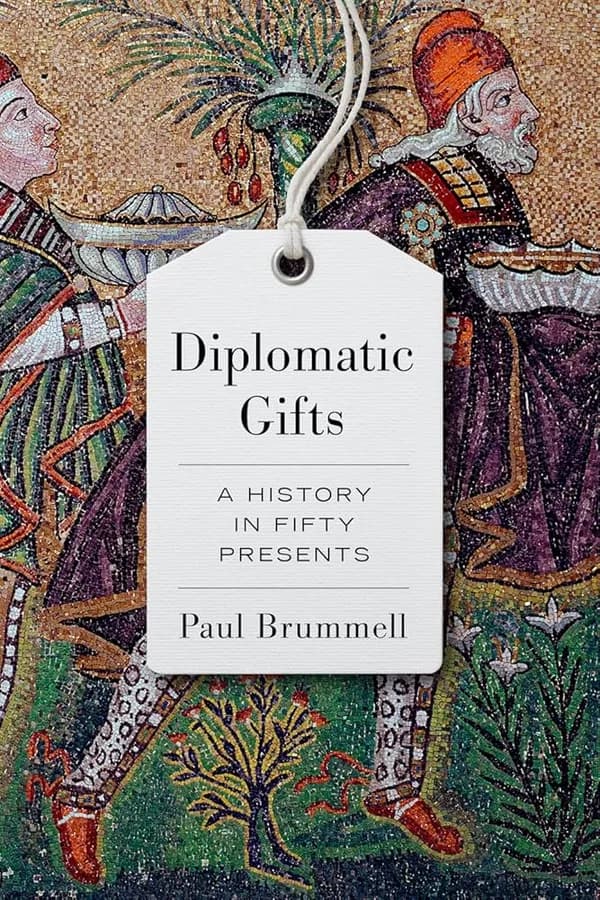
Diplomatic Gifts: A History in Fifty Presents
by Paul Brummell
Book Club Date:September 2023
📖 Book Summary
*The Art of Gift-Giving* is written by a British diplomat with a gift for storytelling. This is not an etiquette manual but a "history of gifts" that dissects international politics. From ancient wars launched to obtain horses, to the modern global craze of "panda leasing," the author reveals that a gift's true value often lies not in its price tag but in the layers of geopolitical metaphor beneath the wrapping. The book shows us Emperor Wu of Han bloodying the kingdom of Dayuan for the "ancient Bugatti" — the Ferghana horse — and reveals the suppressed "Egyptian peasant woman" prequel behind the Statue of Liberty. By analysing these absurd and extraordinary gifts, it redefines how we look at world history.
✍️ Reading Notes
The most brilliant part of this book is how it exposes the "soft power and hard exchange" behind gifts. Take the ancient Ferghana horse (*Hànxuè bǎomǎ*): in its time it was like **a Bugatti among supercars**, extremely precious and rare. Emperor Wu of Han dispatched a hundred-strong embassy with a golden horse replica to purchase them. When Dayuan refused, he launched two military expeditions. This shows that in diplomacy, once a gift is linked to "national security," it transforms from goodwill into a lethal fuse. In the 21st century the tradition continues: the president of Turkmenistan gifted a Ferghana horse to Xi Jinping — not just a present but a historical symbol of power transfer. The most familiar modern example, "panda diplomacy," has evolved into a **precision merger of capitalism and biology**. From Nixon's visit and the gift of Ling-Ling and Hsing-Hsing, to Deng Xiaoping's post-reform "leasing model," pandas shifted from simple friendship gifts to a rent-seeking capital instrument. Interestingly, when relations sour, a panda's "return" is often read as diplomatic cooling. This shows that when a gift has a "life cycle" and "high maintenance costs," it becomes a dynamic political barometer: when we are no longer willing to pay the lease, perhaps the shared interest in "protecting an endangered species" no longer outweighs geopolitical friction. Most surprising is the "PR truth" behind the Statue of Liberty. This gift, regarded as a symbol of Franco-American friendship, actually originated in sculptor Bartholdi's obsession with colossal statues. It was originally designed as an "Egyptian peasant-woman lighthouse" for the Suez Canal, shelved when the khedive ran out of budget. Bartholdi later worked hard to obscure that connection, and she became today's icon of freedom. It reminds us: a gift's meaning is often "added later" — reflecting the narrative that giver and receiver most want to show the world at that moment. Through this book, we see how gifts shape love, hate, and obsession across history, and we appreciate the "confusion and thought process" diplomats go through when selecting gifts. Behind every gift is a precise reading of the global landscape.
💬 Discussion Points
- 1Have you ever received a gift that brought "enormous pressure" (e.g. high upkeep costs or a sense of psychological debt)?
- 2Emperor Wu launched a war for the Ferghana horse, showing that "need" can turn a gift into a form of plunder. In your life or workplace, have you encountered a situation that was "labelled giving but was really exchanging"? Do you think such "unequal exchange" can sustain a lasting relationship?
- 3The Statue of Liberty's story tells us that a gift's symbolic meaning (e.g. freedom) may bear no relation to its original design intent (e.g. an Egyptian peasant woman). Do you think a gift's value is determined by "the giver's intention" or by "the interpretation the recipient assigns"?