
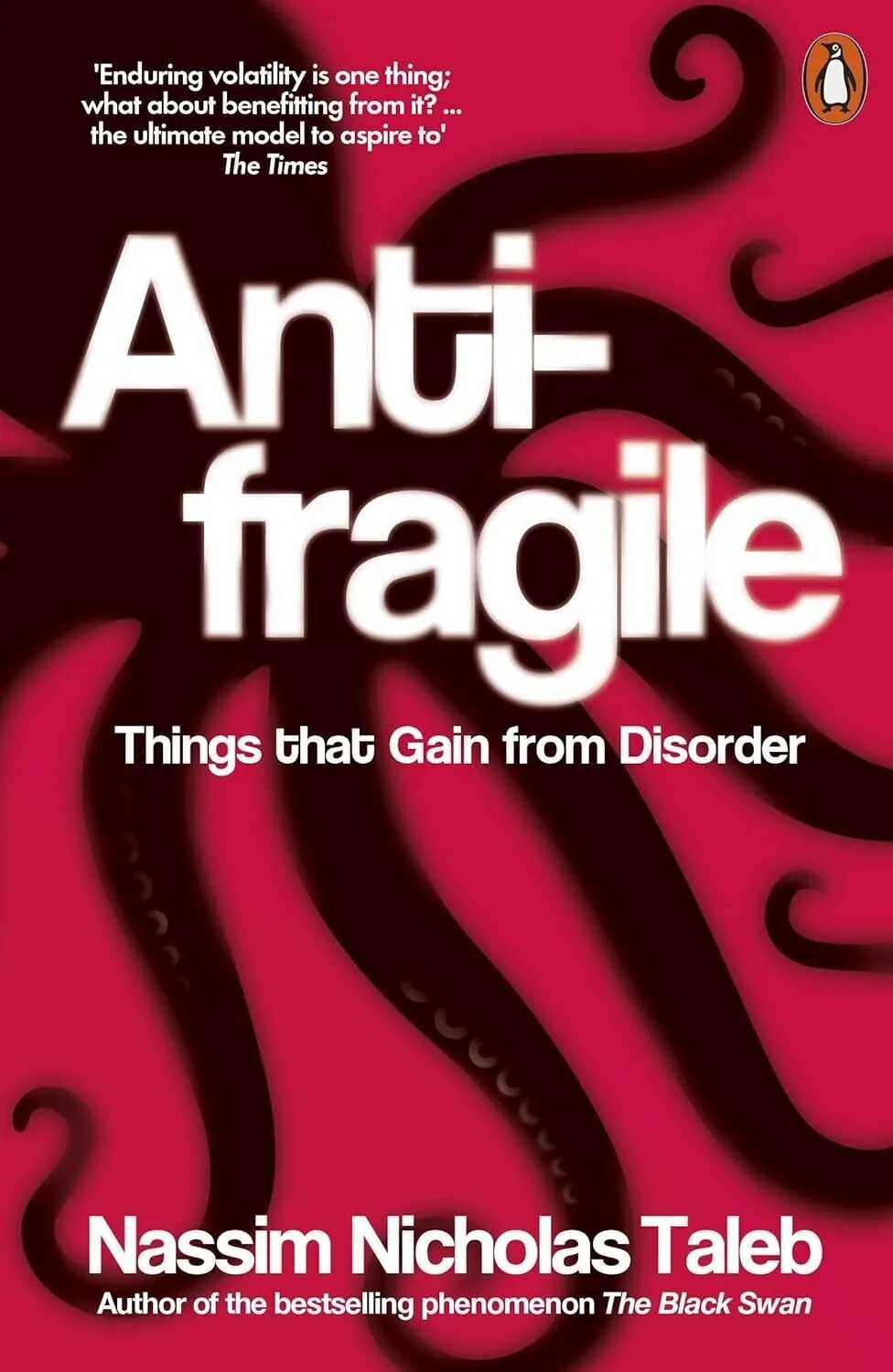
Antifragile
by Nassim Nicholas Taleb
Book Club Date:January 2022
📖 Book Summary
You have probably had this feeling: the harder you try to "plan life to be stable," the more it feels like it could flip at any moment. And the world loves to slip a black swan in right when you are most confident. Nassim Nicholas Taleb's *Antifragile: Things That Gain from Disorder* (2012) challenges our obsession with stability: a truly powerful system is not one that holds up without breaking — it is one that gets stronger under pressure, volatility, and chaos. He divides the world into three constitutions: - **Fragile**: fears volatility; the more it shakes, the easier it cracks (like a glass cup). - **Robust / Resilient**: can take the hit, but taking the hit is all it does (like a rubber ball). - **Antifragile**: needs a little stress to grow muscle; actually thrives the more it is shaken (like human muscles, or certain innovation systems). If you read it as an investment book, you will find the barbell strategy, risk allocation, and black-swan self-defence. If you read it as a life book, it comes down to one sentence: do not chase perfect stability — chase a structure that lets you thrive inside uncertainty.
✍️ Reading Notes
What *Antifragile* most wants to demolish is our fantasy of "controllability." Taleb keeps reminding us: a black swan is called a black swan because it is unpredictable; your job is not to try harder to predict it, but to redesign the way you are exposed to risk. In other words, you may not be able to stop bad things from happening, but you can reduce the chance of being knocked out by a single blow, while keeping space open to catch good things when they arrive. He particularly loathes "optimising a system to the exact limit." Because anything pushed to maximum efficiency usually lacks redundancy — everything looks sleek and productive, but the moment a surprise exceeds the model, it shatters like taut glass. Think of it this way: a person whose schedule is packed to the minute collapses the second one train is late; a person who leaves some blank space can absorb the disruption and even turn it into opportunity. Then there is his most-cited "barbell principle." It is really a life philosophy: put most of your resources into something extremely stable and survival-oriented; put a small portion into attempts with huge upside potential where failure is not fatal. The middle zone — "looks safe but is actually most exposed to systemic risk" — is the one to watch out for. A single income from a single workplace, for instance, was extremely fragile during pandemic lockdowns. But if you had been cultivating a second channel — online courses, community building, content, cross-region services — then when volatility hit, things might not be easy, but at least "wait to die" would not be your only option. Taleb calls this "optionality": a truly antifragile person does not get it right every time — they always keep the possibility of pivoting. My own feeling after reading this is: many of the concepts are not brand-new, but the book's power lies in this — the hardest part was never understanding the concept; it is actually designing your life that way. We all say "don't put all your eggs in one basket," yet in practice we constantly lock ourselves in: one income source, one identity, one definition of success. So when the black swan arrives, you are not just disrupted — you are shattered. Practising antifragility is, in a way, asking yourself: can you leave a little slack in the present, so that the future you has choices?
💬 Discussion Points
- 1What is the "most fragile part" of your life right now — income structure, relationships, health, or self-identity?
- 2If you wanted to make it more antifragile, what is the first small adjustment you could make?
- 3How might you build your own "barbell strategy"? Which part should be more survival-oriented and stable (cash flow, core skills, health habits), and which part should be bolder with more upside potential (side projects, creative work, community, research topics)?